


Categorization:Harness Component
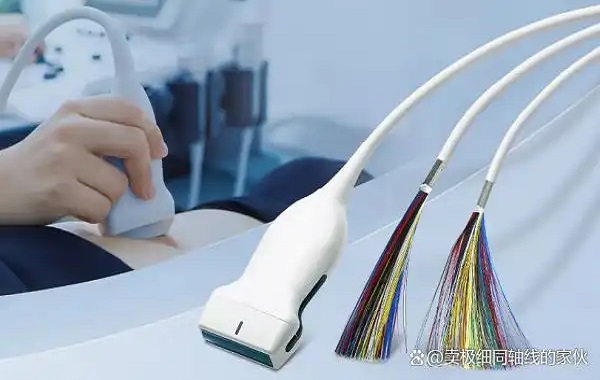
The core performance value of ultra-fine coaxial beam束
The extremely fine coaxial cable束 has high-density signal transmission capability and is an important basis for the realization of multi-channel arrays in ultrasonic probes. Its low capacitance, strict impedance control, and multi-layer shielding design can significantly reduce signal loss and distortion, making the imaging results clearer. The cable束 usually adopts high-conductive copper alloy conductors, paired with low dielectric materials such as PTFE and FEP, improving performance while also considering flexibility and durability. The outer material is often selected as medical-grade PU or silicone sheath, which has excellent bending life and sterilization resistance, enabling it to adapt to frequent operations and usage requirements in medical environments for a long time.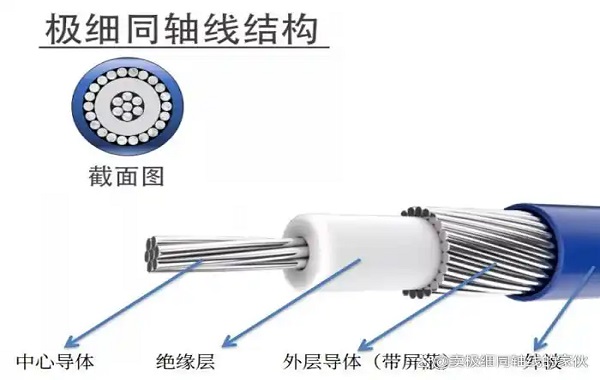
Two, practical applications of ultrasonic and MRI probes
In ultrasonic imaging, the micro coaxial cable achieves a finer tissue resolution through high channel count and high-speed low-loss transmission. At the same time, its flexible structure allows doctors to operate more flexibly and reduces hand fatigue. The MRI environment poses higher challenges to the beam, as strong magnetic fields and temperature changes may interfere with the signal, so the beam needs to have stronger anti-electromagnetic interference capabilities and high stability. In hybrid probes (such as MRI+ultrasound), the shielding layer is often strengthened, and temperature-resistant materials are used to ensure stable signal transmission in complex environments. In addition, the high-density connectors that come with the beam are also crucial, such as the high-density connectors with a 0.4 mm spacing, which can achieve high-speed transmission and comprehensive shielding, providing reliable support for system integration.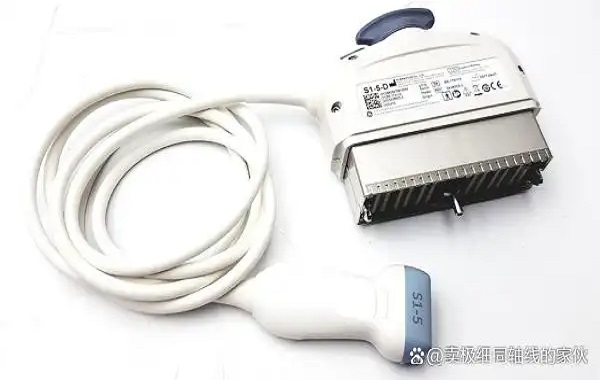
Section 3: Comparison of Transmission Demands for Different Imaging Equipment
The core requirements for ultrasonic transducers are multi-channel, high real-time performance, and high flexibility, therefore the cable must have low loss, high concurrency, and excellent mechanical flexibility, capable of withstanding long-term operation and bending. MRI probes face strong magnetic fields and complex environments, requiring higher performance in shielding, signal purity, and structural stability, and need to withstand the impact of temperature fluctuations. The focus on the cable is different for both, but micro coaxial cable plays a key role in both: emphasizing flexibility and multi-channel in ultrasound, and emphasizing interference suppression and extremely high stability in MRI.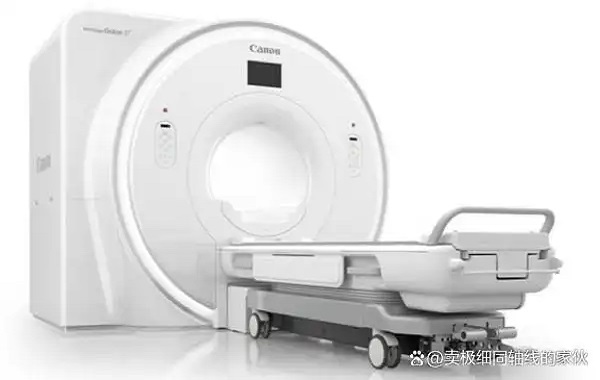
“Without the consent or authorization of this site, no one shall reproduce, reprint, distribute, cite, change, broadcast or publish the content in whole or in part in any form, nor shall there be any other violation of the copyright of this site.