


Categorization:Harness Component
In high-speed signal transmission systems, ultra-fine coaxial cables (Micro Coaxial Cable) have become a common internal interconnection method for high-speed interfaces (such as MIPI, LVDS, PCIe, USB4, etc.) due to their small size, high density, and low crosstalk characteristics. However, during the design stage, many engineers tend to overlook the impedance matching issue between the connectors and the cables. Minor structural discontinuities can lead to signal reflections, frequency response distortion, and even affect system stability.
This article will start from the principles of impedance matching, the challenges of extremely thin coaxial cable束, and the key points of connector matching design, to analyze how to ensure high-speed signal integrity.
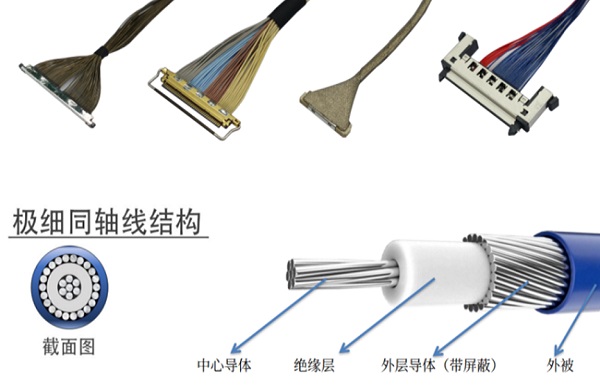
The core principle of impedance matching
The essence of impedance matching is to ensure that the signal sees a "continuous" electrical environment along the transmission path. An ideal coaxial cable has a fixed characteristic impedance (usually 100 Ω or 90 Ω differential), which is determined by the spacing between the inner and outer conductors, the dielectric constant, and the conductor dimensions. If the geometric structure at the interface changes, such as at the connector transition zone, a sudden change in dielectric thickness, or discontinuous shielding, the electromagnetic field distribution of the signal will change, causing reflections. The design goal is to ensure that the signal remains in an impedance continuous environment when it enters the connector from the cable and then into the board end, thereby maintaining signal integrity and system stability.
Special Challenges of Ultra-fine Coaxial Beam
The minute structure of extremely thin coaxial cable束 presents high difficulty in impedance control. The diameter of the central conductor is typically only 0.1 mm, with an outer diameter of about 1 mm or even finer. Any minor error will be amplified into significant electrical discontinuity: geometric tolerances such as conductor eccentricity, variations in insulation thickness, or uneven shielding will affect impedance; poor medium stability may cause fluctuations in local impedance; bending or assembly errors are prone to cause abrupt changes in impedance; and parasitic capacitance and inductance within the connector should not be ignored. These factors make impedance matching of extremely thin coaxial cables more challenging than that of ordinary cables.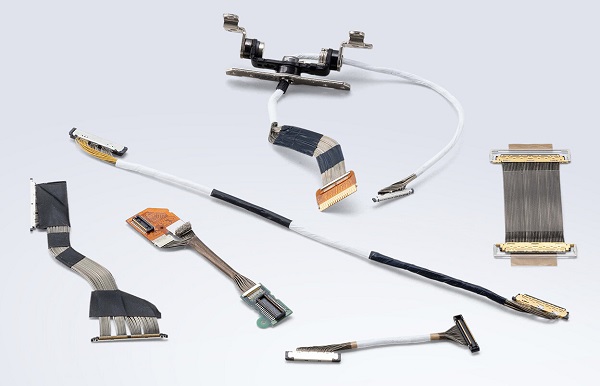
Section 3: Design Points for Connector Matching
In order to ensure the continuity of impedance, the following aspects should be paid special attention to during the design:
Choose a miniature connector that matches the cable, ensuring that the internal conductor ratio and shielding path are continuous.
Design smooth impedance transition structures to avoid geometric abrupt changes, which can reduce reflections by using transition sections or gradient structures.
Maintain the continuity of shielding, ensure the connector housing and cable shielding layer are well grounded to prevent leakage and common-mode noise.
Control stub and contact gap, shorten the signal path, and reduce extra pin length.
Precisely control the machining tolerance to ensure that the conductor eccentricity, insulation thickness, and pressing position meet the requirements.
Considering temperature and stress factors, mechanical stress buffering structures are left in microstructures.
In addition, the termination process, bending control, shielding connection reliability, as well as TDR and S parameter verification are all important aspects for ensuring the matching effect.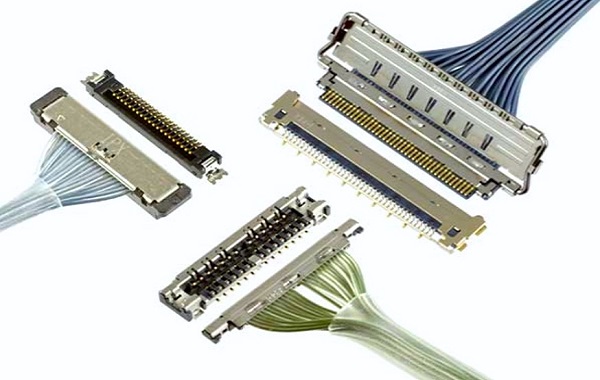
In high-speed interconnect design, impedance matching is not only a theoretical requirement but also a key performance indicator of the system. For extremely thin coaxial cable bundles, the structural accuracy of the connectors, the continuity of shielding, and the assembly process directly affect signal integrity and system stability. Only through reasonable connector selection, transition design, shielding treatment, and strict process control can high-speed and reliable signal transmission be achieved.
I amSuzhou Huichengyuan Electronic Technology,Long-term focused on the design and customization of high-speed signal cable harnesses and ultra-thin coaxial cable harnesses, committed to providing customers with stable and reliable high-speed interconnection solutions. For technical support or selection consultation, please contact Manager Yin:18913280527 (WeChat number)。
“Without the consent or authorization of this site, no one shall reproduce, reprint, distribute, cite, change, broadcast or publish the content in whole or in part in any form, nor shall there be any other violation of the copyright of this site.