With the rapid development of drone technology, there is a higher requirement for the lightweight, miniaturization, and stability of the internal connection system. Especially in key components such as high-definition cameras, image transmission systems, and navigation modules, the choice of signal transmission cables directly affects the equipment performance and operational reliability. This article will focus on the application advantages of extremely thin coaxial cables (micro coaxial cable) in drones, as well as the pairing value of high-performance connector HRS DF36C-15P-0.4SD.
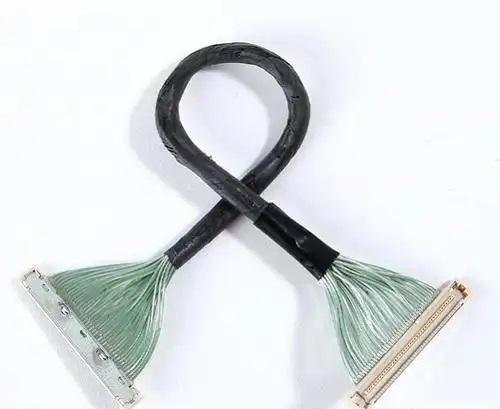
What is a micro coaxial cable (micro coaxial cable)?
A very thin coaxial cable is a high-frequency signal transmission material with a diameter usually ranging from 0.3mm to 1.0mm. Its internal structure consists of an inner conductor, an insulating layer, a shielding layer, and an outer sheath, and it has excellent anti-interference capability and high-frequency signal transmission performance.
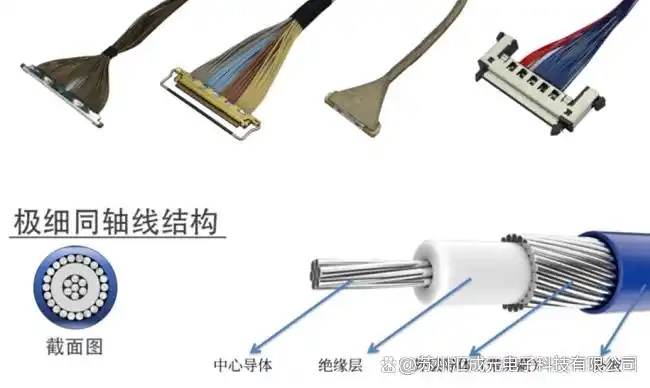
Why do drones rely on ultra-fine coaxial cables?
Light-weighting advantages
Drones are extremely sensitive to load. The extremely thin coaxial cables are much lighter than traditional wiring harnesses, which can effectively reduce the overall weight and improve the endurance capability.
Miniaturized design
Extremely thin coaxial cables have a small volume, making them convenient for wiring in the complex and narrow spaces inside drones. They are particularly suitable for small electronic units such as transmitters, cameras, and GPS modules.
High-speed stable transmission
Its excellent anti-interference and high-frequency characteristics ensure real-time stable transmission of high-definition video and data, avoiding signal loss or delay.
High flexibility and strong bending strength
Cables are soft and flexible, suitable for the frequent movement and vibration environment inside drones, ensuring long-term use without breaking or poor contact.
Excellent EMI electromagnetic shielding performance
Multi-layer shielding structures can effectively isolate external electromagnetic interference, ensuring clear and stable transmission of video and flight control signals, making them suitable for industrial and surveying drones operating in complex environments.
Easy for modular assembly and maintenance
Cooperating with high-density connectors such as HRS DF36C-15P-0.4SD, modular interface management can be achieved, facilitating the quick disassembly, maintenance, and upgrade of internal circuit modules for drones, and improving the overall reliability of the whole machine.
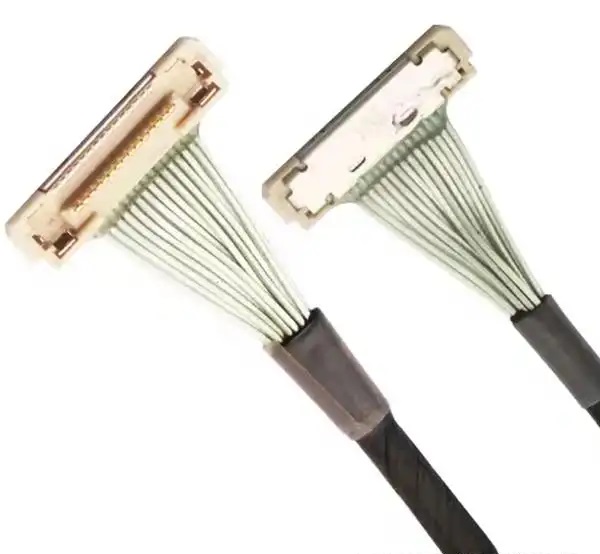
Three, HRS DF36C-15P-0.4SD connector: the best match for ultra-thin coaxial cables
In the application of micro cables for drones, the performance of the connectors is also crucial. HRS DF36C-15P-0.4SD, with its compact design and high-density arrangement, has become a popular choice in the industry.
Product highlights:
Compact design: 0.4mm terminal spacing, 15PIN arrangement, meeting the needs of multi-signal high-speed transmission in a small space.
Excellent adaptability: Supports micro coaxial cable termination, perfectly matching the characteristics of the cable.
Robust vibration resistance: Reinforced buckle design for stable connection during flight.
High frequency performance is excellent: suitable for high-definition image transmission and camera signal interfaces.
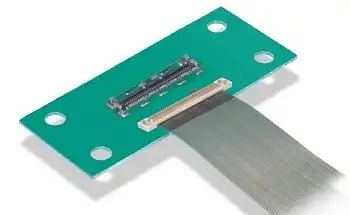
The high requirements of drones for signal transmission systems make the combination of extremely thin coaxial cables and HRS DF36C-15P-0.4SD connectors the best partners for lightweight, miniaturization, and high-speed stable transmission.
We have been focusing on the design and customization of high-speed signal cables and ultra-thin coaxial cables for a long time, committed to providing stable and reliable high-speed interconnect solutions. If you have any related needs or would like to learn more, please contact: Manager Yin.
18913280527 (WeChat same number)。