

Categorization:Harness Component
Why are ultra-fine coaxial cables increasingly used in equipment that requires frequent bending?
In laptops, tablets, display modules, camera modules, VR/AR devices, and other space-compact electronic devices, internal wiring harnesses often need to pass through hinges, narrow channels, or moving structures. Therefore, when engineers choose ultra-thin coaxial cable harnesses, they are not only concerned about high-speed transmission capabilities and cable specifications but also a practical issue: how many times can this wire be bent?
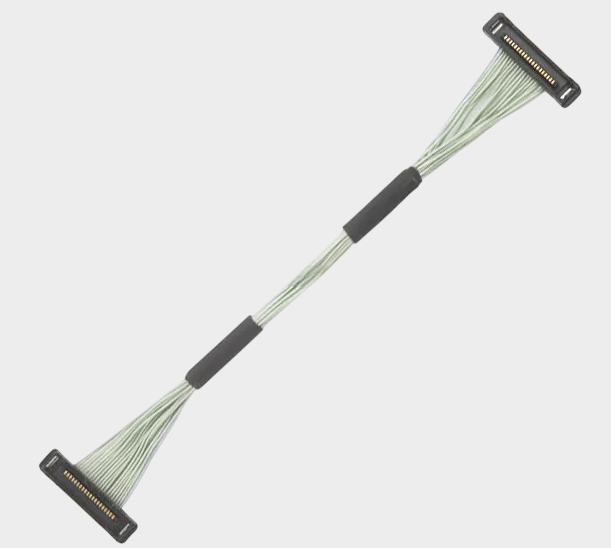
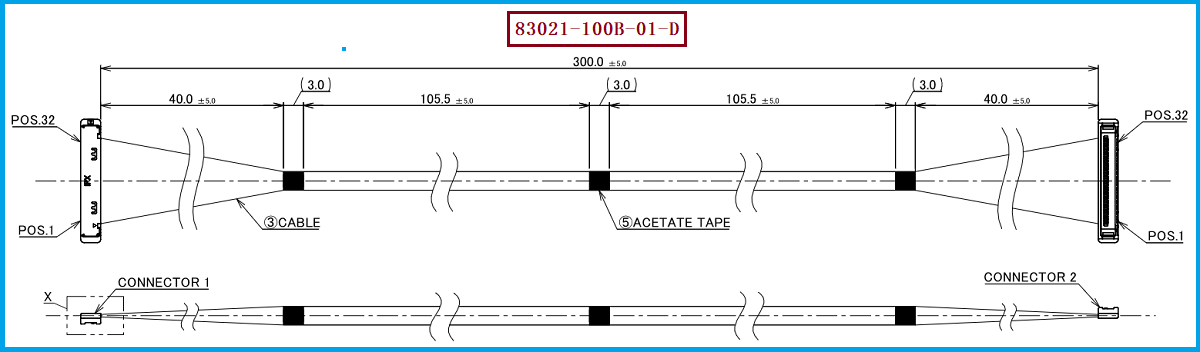
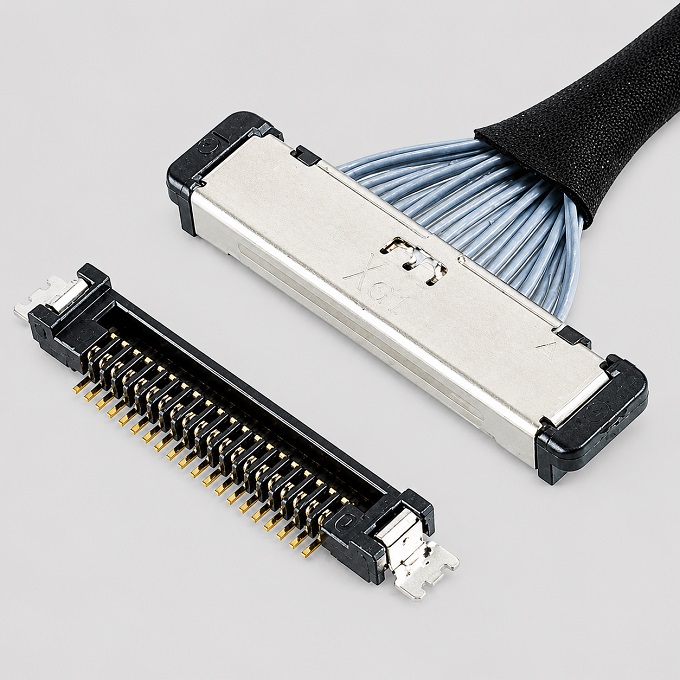
The I-PEX 83021-100B-01-D introduced this time is a 32Pin ultra-thin coaxial cable solution, using the connector model 20373-R32T-06 at the cable end. According to preliminary information, this cable set uses AWG40 ultra-thin coaxial wire, with a length of 300mm and a 1-1 wire sequence. In the corresponding CABLINE-SS connector series documentation, 20373-R32T-06 is explicitly matched with the 32Pin structure and supports Micro-Coaxial Cable related specifications. The I-PEX data shows that CABLINE-SS uses a 0.4mm pitch, vertical right-angle structure, and the combined connector height is about 1.65±0.2mm, with a depth of about 3mm, suitable for internal wiring in devices with limited space.
For engineers, the "bendability" of extremely thin coaxial cable bundles is not simply judged by bending the cable and then restoring it. What truly needs to be concerned about is whether the conductor, insulation layer, shielding layer, and external protective structure experience fatigue during long-term dynamic bending. At the same time, it is necessary to observe whether the impedance, attenuation, crosstalk, and connection stability still meet the equipment requirements after bending. Therefore, the mechanical life and high-speed signal life of extremely thin coaxial cable bundles need to be considered simultaneously.
The bending life of ultra-fine coaxial cable bundles is actually a complex issue and cannot be simply answered with "how many times."
“Can the extremely thin coaxial cable bundle bend 100,000 times, 500,000 times, or even 1,000,000 times?” This is a question that many engineers and procurement personnel often ask during project evaluation. However, from the perspective of engineering testing, there is no unified bending life number that stands alone without脱离 the testing conditions. The same extremely thin coaxial cable may have different lifespans when subjected to different bending radii, bending angles, movement frequencies, tension, fixing methods, and environmental temperatures.
For example, the cable bundle only performs small-angle slow swings, which is completely different from the 180°repeated folding of the cable bundle at the notebook's pivot position. Therefore, if the bending radius is too small, the stress on the conductor and shielding structure will increase significantly; if the cable bundle is subjected to tension, compression, or torsion in the bending area at the same time, its fatigue speed may also accelerate further. Therefore, when engineers evaluate alternative solutions for I-PEX 83021-100B-01-D, it is better to first determine the actual bending radius, activity angle, frequency of movement, number of actions per day, and design life of the product rather than simply asking "how many bends can it make."
Here, it is necessary to specifically differentiate a concept that is often confused: the Durability 30 Cycles in the CABLINE-SS data refers to the connector's insertion and extraction durability test, and it does not mean that the extremely thin coaxial cable bundle at the wire end can only be bent 30 times. The I-PEX related materials also provide the mechanical property requirements for the connector after 30 insertions and extractions.
Therefore, if customers need to confirm the dynamic bend life of extremely fine coaxial cable assemblies, they should formulate a special bend test plan according to the actual product working conditions, and cannot directly use the 30 insertion and extraction data of the connector as the bend life of the cable assembly. For substitute products, it is even more important to verify their dynamic bending, conduction, insulation, and high-speed signal performance through actual samples, thereby determining whether they truly meet the service life of the whole machine.
Three, selection and compatibility and alternative solutions reference and suggestions: AWG specifications, bending radius, and actual working conditions should be confirmed together.
For engineers and purchasers who need to find alternative solutions for I-PEX 83021-100B-01-D, it is recommended not to purchase based solely on "32Pin ultra-fine coaxial cable assembly". Instead, they should confirm the connector, cable, length, wire sequence, and actual installation method of the original product as a whole. The corresponding cable end connector for this model is 20373-R32T-06, with the target cable specification being AWG40. The connector series documentation also involves 36AWG, 38AWG, 40AWG, 42AWG, and other Micro-Coaxial Cable specifications. Therefore, when developing alternatives, specifications should be matched according to specific product requirements, but it cannot be assumed that different AWG specifications can be directly interchangeable without verification. The I-PEX documentation also specifically points out that there are注意事项 regarding characteristic impedance mismatch with AWG42.
If the equipment belongs to a common static wiring setup, engineers may pay more attention to dimensions, impedance, attenuation, and assembly space. If the equipment has long-term dynamic movement, it is necessary to further confirm the mechanical reliability of the harness under actual bending radii. Particularly in applications such as notebook hinges, rotatable cameras, and folding structures, the method of securing the harness in the bending area is very important. A reasonable bending transition, avoiding local sharp bends, and controlling the range of harness movement are often more important than merely pursuing a certain "bend frequency."
From the perspective of procurement alternatives, I-PEX 83021-100B-01-D, 20373-R32T-06, AWG40, 300mm, 1-1 sequence can be used as a basic specification for pricing inquiries, and further requirements such as bending radius, dynamic bending angle, cyclic frequency, and target service life can be proposed. In this way, suppliers can carry out targeted sample development and reliability verification based on the actual working conditions of customers, rather than simply providing a common extremely thin coaxial cable with a similar appearance.
Our company can provide: I-PEX 83021-100B-01-D compatible and alternative cable harness solutions, which can be matched and developed around the 20373-R32T-06 connector, 36AWG/38AWG/40AWG/42AWG wire specifications, and the actual wire length, wire sequence, installation space, and bending conditions of the customer. For projects with dynamic bending requirements, corresponding sample verification can be carried out in cooperation with the actual usage conditions of the customer, providing alternative design references for engineers, and also providing a stable ultra-thin coaxial cable harness alternative supply solution for purchasing personnel.
Four, for dynamic equipment, what truly needs to be concerned about is whether it can still operate stably after bending.
The bending resistance of extremely thin coaxial cable bundles cannot ultimately be determined solely by appearance or by whether the cables are still conductive. For high-speed signal applications, even if a cable bundle remains conductive according to a multimeter test after long-term dynamic bending, it does not necessarily mean that its high-speed transmission performance has not changed. Therefore, for engineers, a more reasonable reliability evaluation method should be to combine the mechanical bending life with the changes in electrical performance.
Taking the 32Pin ultra-thin coaxial cable assembly like I-PEX 83021-100B-01-D as an example, in the actual development process of substitution, the corresponding bending conditions can be set according to the working status of the equipment, and then the conductivity, insulation, contact status, and high-speed signal-related performance can be checked at different test stages. If the project has high requirements for high-speed signal integrity, attention should also be paid to whether there are significant changes in impedance, insertion loss, return loss, and crosstalk before and after bending. The test results obtained in this way are more valuable for engineering reference than simply providing a number of "how many times it can be bent".
At the same time, the CABLINE-SS connector itself adopts the I-PEX W-Point contact structure to improve connection reliability and reduce the risk of poor contact caused by foreign objects; its series specifications support various pin counts such as 32Pin and are compatible with various Micro-Coaxial Cable specifications. This means that during alternative development, it is not only necessary to focus on the wire itself but also to confirm the crimping, assembly, and overall structural matching between the wire and the connector.
Therefore, for purchasing personnel, when selecting a supplier of ultra-fine coaxial cable assemblies, it is recommended not to compare unit prices alone, but to focus on understanding whether the supplier can provide samples of the corresponding specifications according to the actual equipment conditions and whether they can cooperate to complete reliability tests. For engineers, it is advisable to convert the actual bending radius, movement angle, cycle times, and product life cycle into clear test conditions as early as possible. Only in this way can one truly judge whether an ultra-fine coaxial cable assembly is suitable for long-term dynamic use.
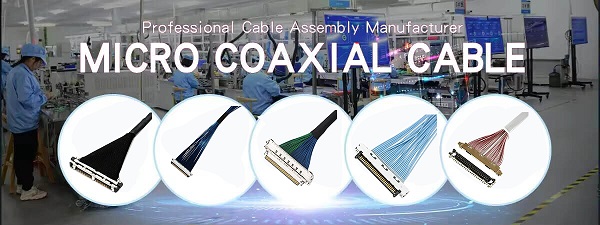
The bending life of extremely thin coaxial cable bundles is actually not a fixed number that is independent of usage conditions. The true determinants of the cable bundle's life are multiple factors such as the structure of the wire material, bending radius, bending angle, frequency of movement, method of fixation, environmental conditions, and actual usage cycle. Especially for high-speed equipment, it is also necessary to pay attention to whether the cable bundle can still maintain stable electrical performance after long-term bending.
For the I-PEX 83021-100B-01-D ultra-fine coaxial cable assembly, the connector model at the cable end is 20373-R32T-06. The involved Micro-Coaxial Cable specifications include 36AWG, 38AWG, 40AWG, 42AWG. When developing a specific replacement, the most suitable cable specification and structure should be determined based on the actual project. For products that require dynamic bending, it is more recommended to conduct targeted reliability tests according to the actual working conditions of the customer rather than simply using a fixed number of bending cycles.
I am[7A Electronic Network]We professionally provide customized and compatible replacement services for high-speed ultra-thin coaxial cable assemblies such as eDP, MIPI, USB3.X/4, LVDS, etc. If you need technical support, please contact: Manager Zhang18913228573 (WeChat same number).
“Without the consent or authorization of this site, no one shall reproduce, reprint, distribute, cite, change, broadcast or publish the content in whole or in part in any form, nor shall there be any other violation of the copyright of this site.