


Categorization:Harness Component
Why do engineers pay attention to ultra-fine coaxial cables under high-speed computation and compact structure?
With the continuous development of AI servers, high-performance computing equipment, and high-speed imaging systems, the internal signal interconnection of devices must not only meet high-speed transmission requirements but also take into account space utilization, electromagnetic compatibility, and structural reliability. For engineers, when choosing cables, it is not enough to simply look at whether the wire is thin enough; they also need to comprehensively evaluate signal frequency, transmission loss, crosstalk, wiring space, and connector matching design.
Then, why would engineers consider ultra-fine coaxial cables instead of traditional FFC ribbon cables in some high-performance computing and high-speed interconnect design scenarios? The key differences lie in structure and electrical characteristics: FFC typically uses a flat structure with multiple parallel conductors, offering advantages such as thinness and ease of batch wiring; ultra-fine coaxial cables, on the other hand, provide a relatively independent transmission channel for a single signal through a central conductor, insulation layer, and external shielding structure. Reasonably designed coaxial structures are beneficial for controlling characteristic impedance, reducing the impact of external electromagnetic interference, and helping engineers manage the risk of crosstalk between high-speed signals.
It should be noted that it cannot be simply said that all NVIDIA devices or all designs recommend extremely thin coaxial cables and exclude FFC. The actual selection should still be based on specific device architecture, interface specifications, signal rates, and manufacturer design requirements. For high-speed differential signal internal interconnections that are space-limited and have high requirements for signal integrity, extremely thin coaxial cables are worth including in the engineering evaluation scope; while in some low-speed control, power supply, or scenarios where wiring cost and simplicity are more sensitive, FFC may also be an appropriate solution.
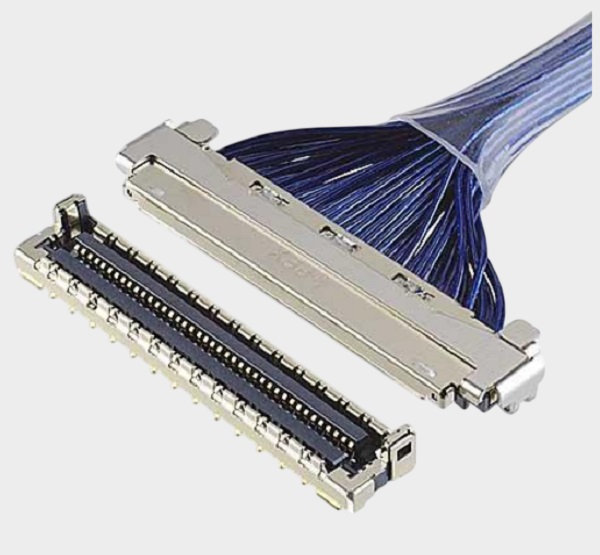
I-PEX 83042-100B-01-D ultra-fine coaxial cable assembly, an alternative solution for high-density interconnects
The product model introduced this time is I-PEX 83042-100B-01-D, corresponding to the CABLINE-UM series 50 Pin, 300 mm ultra-thin coaxial cable assembly evaluation sample specification. According to the product information read, this model belongs to a 1-1 Pin Assignment cable scheme with both ends connected, using 40AWG Micro-Coax cable material. The CABLINE-UM series connectors are designed with 0.4 mm contact spacing, suitable for compact, high-density board-to-board interconnect structures; the series documentation also introduces features such as shielding design and mechanical locking structure. It should be noted that the high-speed transmission capability supported by the series does not mean that each specific cable assembly has been verified at the same rate, and the actual performance still needs to be confirmed by combining the cable material, length, termination process, and overall machine testing.
The harness is配套 used with wire end connector model 20878-050T-01, its compatible wire material AWG specifications include 36AWG, 38AWG, 40AWG, 42AWG, 44AWG. Different wire diameters affect the flexibility, mechanical strength, conductor resistance, and high-frequency transmission performance of the harness, therefore, it cannot be determined whether it is fully compatible solely based on the AWG range. It is necessary to check the wire outer diameter, impedance requirements, termination structure, connector assembly conditions, and actual electrical performance in use. For engineers, these details are related to design verification and subsequent mass production; for purchasing personnel, specifying the model, length, pin count, and wire specifications helps to reduce communication errors during quotation, sample confirmation, and alternative introduction processes.
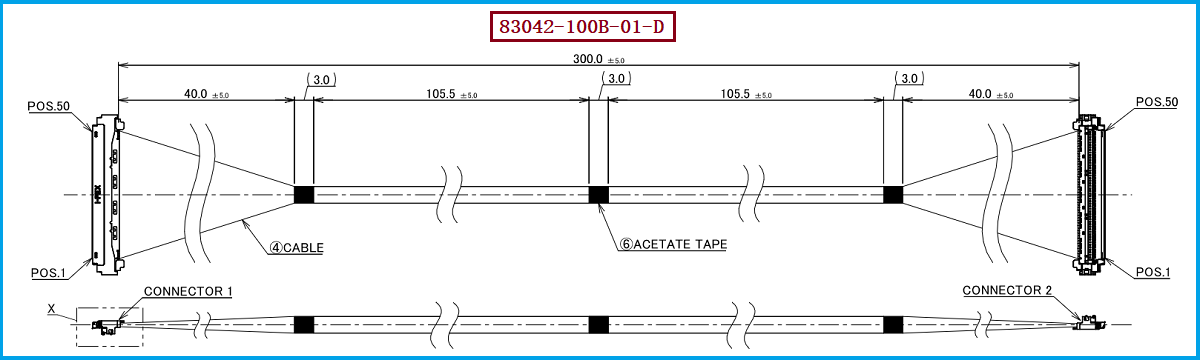
Section 3: Selection, Compatibility, and Alternative Solutions Reference and Recommendations
For engineers and procurement personnel, when evaluating compatible alternatives for the I-PEX 83042-100B-01-D, it is recommended to base the assessment on the original drawings and actual installation requirements, prioritizing the verification of the 50 Pin quantity, 300 mm cable length, connection methods at both ends, pin definition, and electrical parameters of the wire material. This model corresponds to a two-end connection sample cable assembly with 50 Pins, 300 mm, and 40AWG ultra-thin coaxial cable in the I-PEX CABLINE-UM series documentation; the matching connector 20878-050T-01 is the 50 Pin Plug Housing of the CABLINE-UM series. The series uses a 0.4 mm contact spacing and provides shielding and mechanical locking design. The above information can serve as a preliminary selection basis, but it cannot replace the confirmation of the actual mating connector, wire sequence, dimensional tolerance, and electrical performance.
During the process of alternative import, the AWG specification needs to be handled with particular caution. Although the connector data sheet lists compatible wire material specifications such as 36AWG, 38AWG, 40AWG, 42AWG, and 44AWG, there may be differences in outer diameter, impedance matching, attenuation, and bending characteristics between different wire diameters; the I-PEX series data sheet also specifically cautions that some AWG44 wire materials may have non-matching characteristic impedance.
Therefore, purchasing personnel should not simply determine compatibility based on the same connector model or AWG of the wire material. The engineering team should confirm the alternative solution by considering the target signal rate, routing path, installation space, and testing requirements. Our company can provide: I-PEX 83042-100B-01-D compatible alternative cable solution, which can evaluate line length, pin position, wire material specifications, and connector matching solutions according to customer needs, and cooperate to confirm samples and verify performance according to project requirements. The final applicability of the alternative solution should be based on the drawings, specifications, and verification results confirmed by both parties.
Why focus on ultra-fine coaxial cables? From NVIDIA's high-performance computing needs to procurement evaluation
To clarify the topic of "Why NVIDIA recommends ultra-fine coaxial cables instead of FFC ribbon cables," it is necessary to first point out that the publicly available NVIDIA cable guidelines mainly discuss copper cables, active optical cables, and optical modules for high-speed interconnects in data centers. This does not necessarily confirm that NVIDIA explicitly recommends ultra-fine coaxial cables for all devices while excluding FFC ribbon cables.
A more accurate understanding is that in the internal interconnection design of high-density electronic devices, engineers will make choices between ultra-thin coaxial cables, FFC, and other interconnection options based on high-speed signal integrity, shielding requirements, wiring space, and mechanical structures. The independent shielding structure of ultra-thin coaxial cables is beneficial for controlling electromagnetic interference and crosstalk risks, while thin wire materials facilitate wiring in compact spaces. FFC has its own advantages in flat wiring, cost control, and some low-speed or general signal applications. The choice of which option to use ultimately depends on the specific circuit and verification results, rather than solely on brand or application labels.
For enterprises with needs for cable development, alternative procurement, or cost reduction, confirming the interface model, Pin count, wire sequence, wire length, material specifications, and testing standards in advance helps to reduce the risks of design changes and mass production. We focus on the production of extremely thin coaxial cables and can evaluate compatibility and alternative solutions based on customer-provided drawings, samples, and application requirements, providing more choices for engineering design and procurement supply chains. For the I-PEX 83042-100B-01-D, it is recommended to confirm each item from aspects such as connector matching, wire sequence verification, mechanical assembly, and target signal performance before proceeding with sample testing and mass production evaluation.
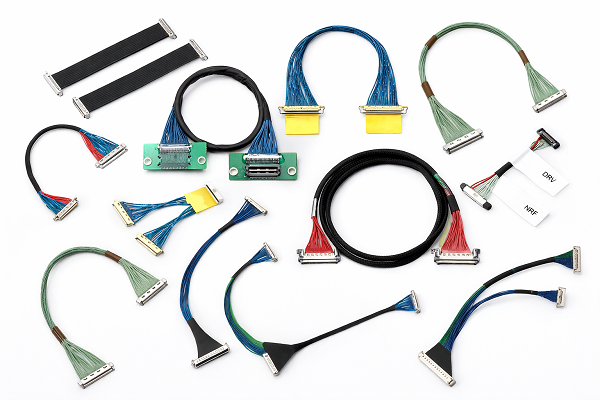
I-PEX 83042-100B-01-D is a 50 Pin, 300 mm CABLINE-UM ultra-thin coaxial cable specification, matched with wire end connector model 20878-050T-01. The ultra-thin coaxial cable is not simply a matter of superiority or inferiority compared to FFC; it is suitable for different design constraints. For projects focusing on high-speed transmission, shielding performance, and compact wiring, it is recommended to evaluate based on actual interface and signal requirements. Our company can provide compatible alternative cable solutions for I-PEX 83042-100B-01-D to assist customers in specification verification, sample validation, and alternative introduction.
I am【7A Electronic Network】Professionally providing mature alternative solutions and engineering, product support for high-speed ultra-fine coaxial cable assemblies and connectors. If you need, please contact: Manager Yin18013280527 (WeChat same number).
“Without the consent or authorization of this site, no one shall reproduce, reprint, distribute, cite, change, broadcast or publish the content in whole or in part in any form, nor shall there be any other violation of the copyright of this site.