


Categorization:Harness Component
One, 32Pin ultra-fine coaxial cable assembly: A precise cable assembly solution for high-density, high-speed internal connections
With the increasing demand for high-speed signal transmission within laptops, tablets, VR/AR devices, display modules, and AI equipment, traditional large-volume cables are increasingly difficult to meet the design requirements of "miniaturization, high-speed, and high reliability." Ultra-thin coaxial cables, with their smaller wire diameter, higher wiring density, and excellent high-speed signal transmission characteristics, are gradually becoming an important solution for high-speed connections within precision electronic devices.
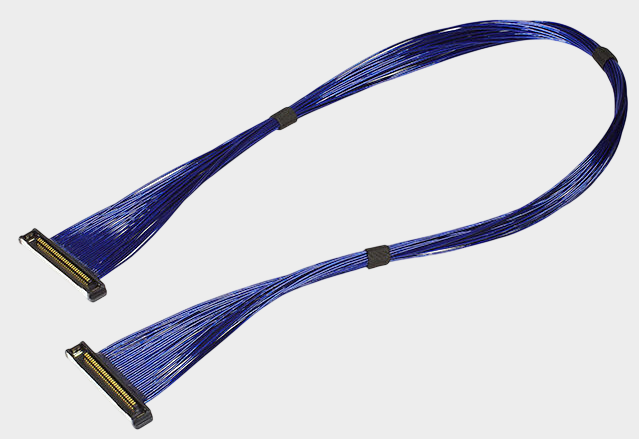
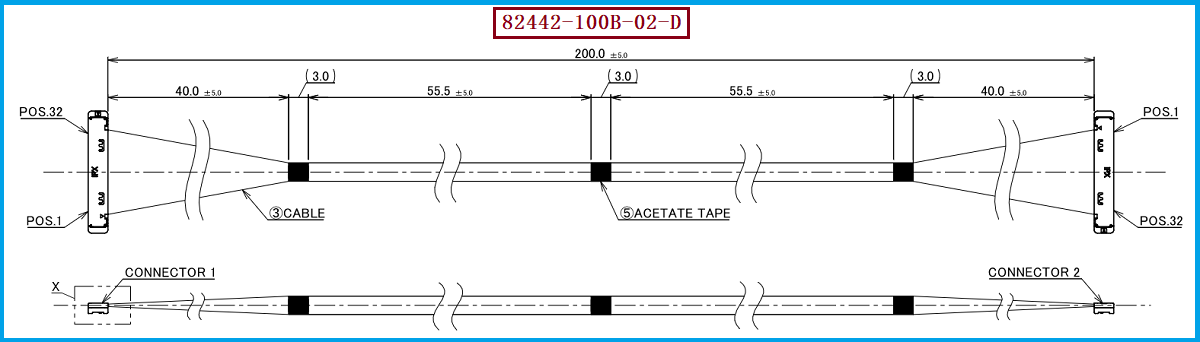
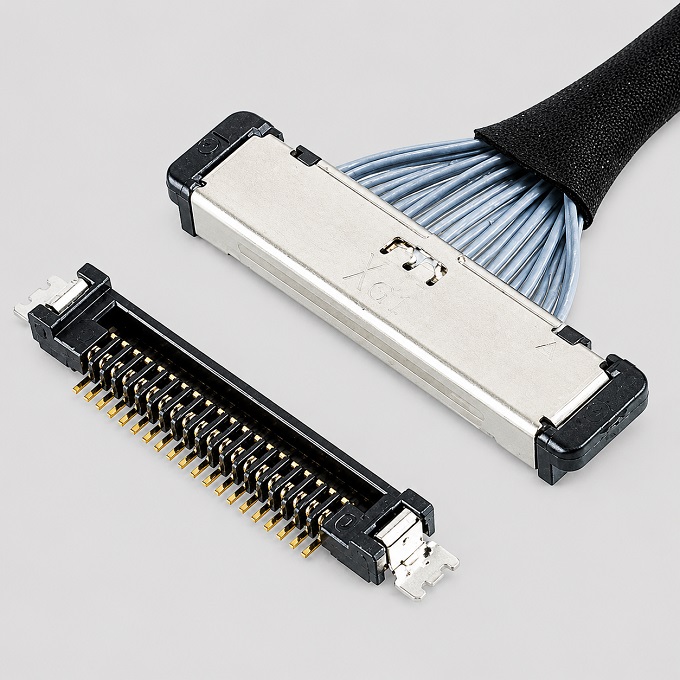
This product introduced is the I-PEX 82442-100B-02-D ultra-thin coaxial cable assembly, corresponding to the CABLINE-SS series 32Pin, 200mm specification, with wire position defined as 1-N. From the connector matching relationship, the connector model used at the cable end is 20373-R32T-06, which belongs to the CABLINE-SS 32Pin Plug Housing. According to I-PEX official data, CABLINE-SS uses 0.4mm terminal spacing, and the Plug Housing model for the 32Pin specification is 20373-R32T-06, which supports different cable specifications such as Micro-Coaxial Cable AWG36, AWG38, AWG40, and AWG42.
For engineers, the core value of such products is not just that "the wire is very thin," but that they can complete stable transmission of multi-channel high-speed signals within the limited internal space of the equipment. For purchasers, parameters such as 82442-100B-02-D, 20373-R32T-06, 32Pin, 0.4mm Pitch, 1-N wire position definition, and corresponding AWG wire material specifications are the key factors that need to be confirmed when making selection, sampling, BOM verification, and supplier substitution evaluation.
The speed of a very fine coaxial cable bundle versus an HDMI cable depends on various factors and cannot be determined solely by looking at the "cable" itself.
In engineering projects, a common question often arises: "Which is faster, the extremely thin coaxial cable bundle or the HDMI cable?" In reality, this question cannot be simply understood as a competition between the speeds of two types of "cable materials." The transmission speed ultimately depends on the interface, signal standard, cable structure, impedance control, connector, and the overall high-speed link design, rather than simply being determined by whether the cable is "thick or thin."
For example, taking CABLINE-SS, the official documents of I-PEX position it as an extremely thin coaxial connection solution suitable for high-speed data transmission, and provide a high-speed application positioning of up to 16Gbps/Lane; their documents also list reference standards such as V-by-One US 16Gbps/Lane, HDMI 2.1 12Gbps/Lane, and USB 3.2 Gen 2 10Gbps/Lane.
Therefore, simply comparing "nominal speed" cannot directly say that "extremely thin coaxial cable assemblies are always faster than HDMI." A more accurate understanding should be: HDMI is a set of audio/video interface/transfer standards, while extremely thin coaxial cable assemblies are a type of cable form used for high-speed signal connections within devices. For example, HDMI 2.1 can support a maximum total link data rate of 48Gbps, but whether a specific device reaches this speed also depends on factors such as the HDMI interface version, channel count, signal encoding, cable, and device-side chips; while the 16Gbps/Lane mentioned in the CABLINE-SS data is a reference to its connector/cable system's capability under specific high-speed application conditions.
So, when engineers are designing a scheme, they should pay more attention to "how much Gbps is needed for actual application, how much speed each lane requires, what the impedance is, how many signal paths there are, and whether the connectors and cables meet the SI requirements," rather than simply judging which type of cable "is faster." This is why extremely thin coaxial cables can be applied in scenarios such as high-speed displays, camera module modules, and internal high-speed connections of devices.
Section 3: Selection, Compatibility, and Alternative Solutions Reference and Recommendations: Comprehensive confirmation from material number, AWG to wire position definition
For the I-PEX 82442-100B-02-D 32Pin ultra-thin coaxial cable assembly, if a company is looking for compatible alternative supply solutions, engineers and purchasers are advised not to judge solely based on "similar appearance." Instead, they should confirm from multiple dimensions including connector, Pin number, Pitch, wire material AWG, length, wire position definition, and high-speed signal performance.
The wire-end connector model corresponding to this solution is 20373-R32T-06, 32Pin, 0.4mm Pitch, with wire position defined as 1-N. The I-PEX official documentation states that the CABLINE-SS series can be paired with various Micro-Coaxial Cable specifications, including AWG36, AWG38, AWG40, and AWG42; among them, AWG42 is specifically noted to pay attention to characteristic impedance matching issues. The official high-speed test example uses AWG40, 45Ω, 100mm Micro-Coaxial Cable, and conducts high-speed transmission tests with GSSGSSG Pin Assignment.
Therefore, if the project goal is to develop a compatible alternative harness for 82442-100B-02-D, it is recommended to prioritize confirming the actual AWG specification, characteristic impedance, wire length, Pin Assignment, connector structure, and termination process used by the original product. Among them, the AWG specification cannot be simply understood as "the thinner, the better": While a thinner wire diameter is beneficial for spatial layout, high-speed signal applications must also take into account impedance consistency, attenuation, crosstalk, and signal integrity.
For the procurement side, if there are issues with delivery time, cost, MOQ, or supply stability in the existing supply channels, the material number can be used as the basic model for project alternative development. It is then recommended to request samples from suppliers for verification of structural dimensions, terminal fit, conductivity, insulation, and high-speed signal performance, rather than directly determining "complete equivalence" based solely on the material number or appearance.
Our company can provide: I-PEX 82442-100B-02-D compatible cable harness solution, which can be developed and manufactured according to customer project requirements, focusing on 32Pin, 1-N pin position definition, connector model 20373-R32T-06, and corresponding ultra-thin coaxial cable material specifications. We provide engineers with sample verification and specification matching reference, and also offer domestic/substitute supply channel options for procurement personnel.
Why choose ultra-fine coaxial cable束:the comprehensive value of high speed, miniaturization and supply alternative
For electronic devices with limited space and continuously increasing signal rates, the advantages of extremely thin coaxial cable bundles are not only reflected in "small volume" but also in the ability to concentrate multiple high-speed signals in a limited space. CABLINE-SS adopts a 0.4mm pitch, and official data shows that its配套 structure has a smaller connector size, supports 32Pin and other Pin numbers, and can select different specifications of Micro-Coaxial Cable according to different applications.
From the perspective of product development, I-PEX 82442-100B-02-D is suitable as a target reference model for engineers to carry out replacement development. Its 32Pin, 200mm, 1-N pin definition, and the matching relationship with the 20373-R32T-06 connector can serve as an important basis for harness design, sample production, and project verification. For purchasing personnel, by specifying the product part number, connector model, AWG specification, and pin definition, it can reduce information deviation in supplier communication and improve the efficiency of alternative product evaluation.
It should be particularly noted that the "high-speed" of extremely fine coaxial cable bundles does not necessarily mean they have a fixed transmission speed. What truly determines whether a high-speed link can work stably is the entire system, including the chip, connector, cable material, and PCB routing. Therefore, in actual replacement projects, the original design specifications of the customer and the actual test results should be used as the final judgment criteria.
The I-PEX 82442-100B-02-D represents a 32Pin, 0.4mm Pitch, 1-N ultra-fine coaxial cable assembly solution, reflecting the trend of internal connections in high-speed electronic devices towards "miniaturization, high density, and high speed." For enterprises seeking original cable assembly alternatives, second-source suppliers, or domestic supply solutions, accurately verifying connectors, AWG wire materials, wire position definitions, lengths, and high-speed performance can enable a more scientific compatibility and replacement assessment. Our company specializes in the production and manufacturing of ultra-fine coaxial cable assemblies and can provide I-PEX 82442-100B-02-D compatible and alternative cable assembly solutions, offering corresponding cable assembly product support for engineering development, sample verification, and bulk procurement.
I am[7A Electronic Network]Our company has a comprehensive production system and technical team for extremely fine coaxial cable assemblies, capable of meeting customized and alternative needs for various types of coaxial cable assemblies; welcome to contact: Manager Zhang18913228573(WeChat same number).
“Without the consent or authorization of this site, no one shall reproduce, reprint, distribute, cite, change, broadcast or publish the content in whole or in part in any form, nor shall there be any other violation of the copyright of this site.