


Categorization:Harness Component
Solution 1: 50Pin High-Density Connection: Focus on I-PEX 82864-100B-02-D ultra-fine coaxial cable assembly
Today, with the continuous development of high-speed electronic equipment towards thinness, lightness, and high integration, the internal high-speed signal connections of equipment have higher requirements for the size, impedance, shielding performance, and connection reliability of the cables. For engineers, cables are no longer just about "connecting two connectors"; they are an important part of the high-speed signal chain. For purchasers, it is necessary to pay attention to factors such as original material numbers, connector matching, wire specifications, wire position definition, and supply stability. In response to such needs, our company can provide an I-PEX 82864-100B-02-D compatible cable solution, offering ultra-thin coaxial cable manufacturing services to customers who require domestication, supply chain optimization, or second supplier introduction.
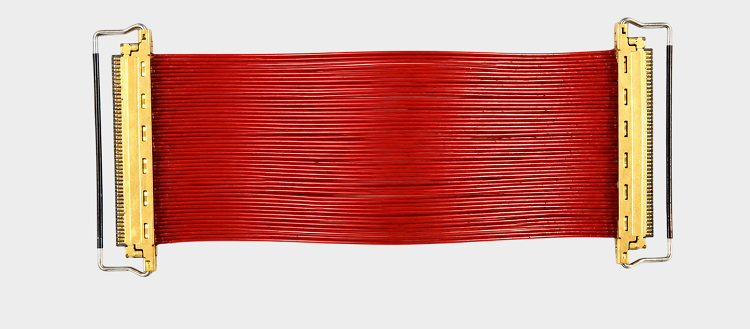
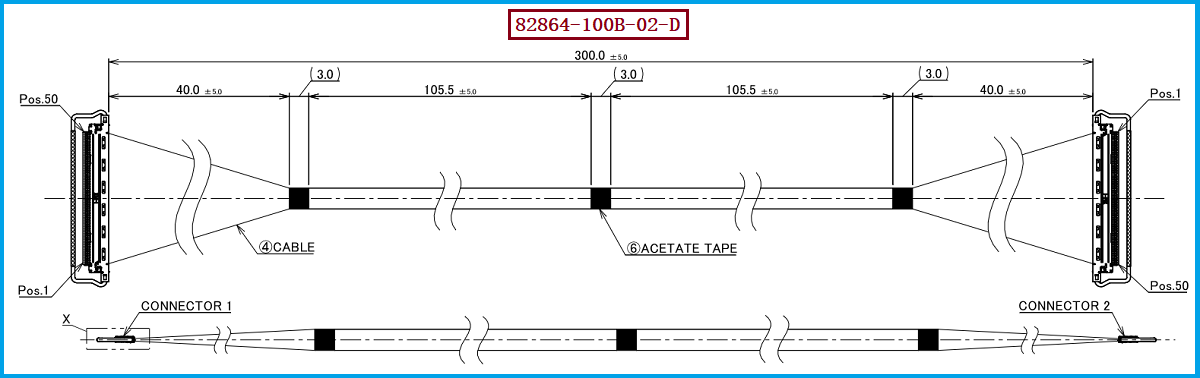
The key product model this time is I-PEX 82864-100B-02-D, which belongs to the I-PEX CABLINE®-CA series of ultra-fine coaxial cable assemblies. According to the product drawings, the cable assembly uses a **50Pin Micro-Coaxial Cable (ultra-fine coaxial cable)** structure, with wire specifications of 40AWG, 50Ω, and a standard cable length of 300mm. The wire position definition is in 1-N manner. The wire end connector uses I-PEX 20634-150T-02, which is compatible with the CABLINE-CA series connection structure, achieving high-density, low-space occupation high-speed internal signal connections. For engineers, the value of this solution lies in being able to arrange more high-speed signal channels within the limited internal space of the device; for purchasers, specifying the specific material number, connector model, wire diameter, and wire position definition is more conducive to BOM verification, sample verification, and supplier substitution.
Why does the length of ultra-fine coaxial cable bundles affect signal quality? 300mm is not just a dimensional parameter.
In high-speed signal transmission systems, the cable length is not only a mechanical parameter that affects whether it can fit in, but also influences the overall electrical performance of the entire link. As the signal rate increases, the attenuation, reflection, crosstalk, and impedance continuity during signal transmission become more and more worthy of attention. For 40AWG extremely thin coaxial cables, they have smaller outer diameters and higher wiring flexibility, and at the same time, the coaxial structure provides a shielding environment for high-speed signals; however, as the transmission distance continues to increase, the signal still needs to go through a longer propagation path, so insertion loss and high-frequency attenuation usually become more obvious with the increase in length. For engineers, it cannot be simply assumed that "the same cable, if the length is doubled, the signal quality will only drop a little." Instead, a comprehensive evaluation should be made based on the actual transmission rate, working frequency, cable structure, connector, and the overall system link budget.
For example, with the 82864-100B-02-D, its standard wire length is 300mm. In actual high-speed designs, 300mm is a relatively common wire harness length within device internal connections, but it does not mean that all applications can arbitrarily increase or decrease the wire length. Changes in wire length may bring about changes in propagation loss, delay, and impedance continuity, and the transition area between connectors and cables may also become a critical position in high-speed links. Therefore, engineers should evaluate "length, wire diameter, impedance, connector, and signal rate" as a complete system when selecting wire harnesses. Especially when devices are used for high-speed display, high-speed video, and high-bandwidth data transmission, it is more important to avoid selecting based solely on mechanical length. For purchasers, if alternative solutions require adjusting the 300mm standard length, it is also recommended to conduct actual signal tests at the sample stage, rather than just judging compatibility based on appearance and dimensions.
How do engineers and purchasing personnel select: Compatibility and alternative solution reference and suggestions
For the compatibility and alternative of I-PEX 82864-100B-02-D, it is recommended that engineers first confirm whether the device connector and PCB layout match the CABLINE-CA system. Then, check the wire harness pin count, wire position definition, wire material specification, and length. This product corresponds to a 50Pin, 40AWG, 50Ω Micro-Coaxial Cable, 300mm, 1-N, with the wire end using I-PEX 20634-150T-02. The "1-N" wire position definition is particularly worth noting, as the alternative wire harness cannot simply achieve "all 50 wires connected" but also needs to ensure that the corresponding relationship at both ends is consistent with the original design. Otherwise, even if it can be mechanically installed, it may cause misalignment of the signal channel. For engineers, it is recommended to focus on verifying the connector size and mating relationship, 50Pin wire position definition, cable impedance, wire length tolerance, end processing, and fixed structure during the alternative development stage, and to combine actual equipment for high-speed signal integrity verification.
For purchasing personnel, if the goal is to find a stable supply channel outside of the original factory, I-PEX 82864-100B-02-D can be used as a benchmark model to establish alternative specifications from several dimensions such as "connector model + cable specification + pin count + length + wire position definition + electrical performance", rather than simply using "coaxial cable bundle" as the procurement description. Our company can provide I-PEX 82864-100B-02-D compatible alternative cable assembly solutions, and can carry out sampling, specification confirmation, and mass production of extremely fine coaxial cable assemblies according to customer actual application needs, providing配套 support for customers who need domestic substitution, supply chain diversification, and long-term stable supply. It is also recommended to complete sample confirmation and electrical performance verification before formal mass production for projects with different lengths, different routing methods, or special terminal structure requirements, to ensure that the alternative cable assembly truly meets the requirements of the whole machine application.
Four, from "connectable" to "stable high-speed transmission": the real value of extremely fine coaxial cable束
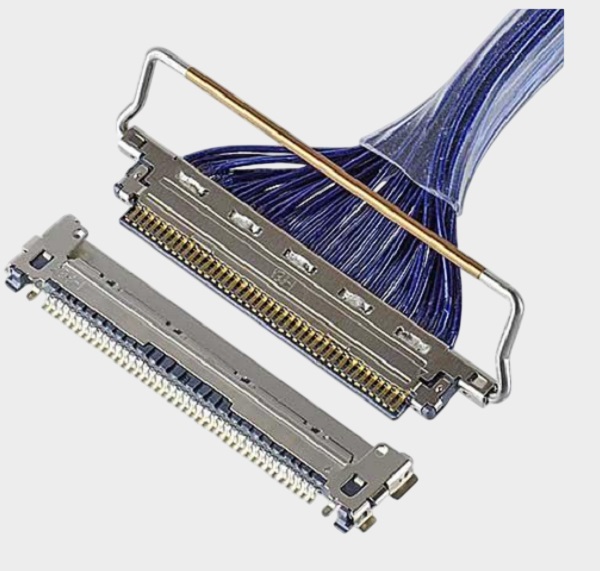
For high-speed electronic devices, an excellent ultra-fine coaxial cable assembly is not simply a combination of connectors and thin wires, but requires a simultaneous consideration of signal transmission, spatial layout, mechanical reliability, and production consistency. The CABLINE®-CA series adopts a 0.4mm contact spacing, horizontal insertion structure, and mechanical locking design, and supports various cable solutions such as Micro-Coaxial Cable; the product documentation indicates that this series is designed for high-speed, miniaturized, and high-density internal connection applications. For a 50Pin cable assembly using 40AWG ultra-fine coaxial wires, it is even more important for the manufacturing end to have stable terminal processing, wire sequence control, welding, and fixation techniques, as the finer the wire, the more important consistency control is during the manufacturing process.
Therefore, for the typical I-PEX 82864-100B-02-D 50Pin, 40AWG, 300mm, 1-N ultra-fine coaxial cable assembly product, engineers are concerned with the stability of the high-speed signal chain, whether the cable length and impedance meet the design requirements, and purchasers are concerned about whether the specifications are accurate, whether alternatives are reliable, and whether supply is stable. Our company focuses on the production and manufacturing of ultra-fine coaxial cable assemblies and compatible alternatives, and can provide corresponding I-PEX 82864-100B-02-D compatible alternative cable assembly solutions based on the actual product requirements of customers. From connector matching, 40AWG ultra-fine coaxial cable material, 50Pin wire position definition, to cable length and cable assembly process, we are committed to helping customers reduce the difficulty of alternative development, while meeting the product structure requirements, and providing reliable cable assembly solutions for internal connections of high-speed electronic equipment.
I-PEX 82864-100B-02-D is a typical high-density ultra-fine coaxial cable assembly solution, with core specifications including 50Pin, 40AWG, 50Ω, 300mm, and 1-N wire position definition. The cable ends are fitted with an I-PEX 20634-150T-02 connector. For high-speed applications, cable length not only concerns the mechanical assembly space but is also closely related to signal attenuation, transmission delay, and overall signal integrity. Therefore, comprehensive evaluation of the entire high-speed link is required during selection. In response to the needs for OEM replacement, domestic procurement, and second supplier development, our company can provide I-PEX 82864-100B-02-D compatible cable assembly solutions. With our professional manufacturing capabilities for ultra-fine coaxial cables, we offer engineers and purchasers more flexible high-speed cable assembly options.
I am[7A Electronic Network]We have mature production and engineering R&D experience in the field of extremely fine coaxial cable bundles, and can assist with model matching and structural substitution. For inquiries, please contact: Yin Manager.18013280527 (WeChat number).
“Without the consent or authorization of this site, no one shall reproduce, reprint, distribute, cite, change, broadcast or publish the content in whole or in part in any form, nor shall there be any other violation of the copyright of this site.