


Categorization:Harness Component
One: Recognize the I-PEX 81464-100B-02-D ultra-thin coaxial cable assembly for high-speed equipment connection needs
In notebook computers, ultra-thin display devices, industrial vision systems, and high-speed data transmission equipment, the internal connection space is continuously shrinking, while the signal rate is continuously increasing. How to balance high-speed signal transmission, anti-interference capability, and connection reliability within limited wiring space has become a key issue for electronic hardware engineers when selecting cable harnesses. The I-PEX CABLINE®-SS series is a fine coaxial connector series designed for high-density, miniaturized connection requirements, featuring 0.4mm pin spacing, a compact structure, and high-speed signal application capabilities. The I-PEX 81464-100B-02-D fine coaxial cable harness, which is the 40Pin, 200mm standard cable harness component of this series, uses Micro-Coaxial fine coaxial cable, with cable specifications of AWG 40 and cable connector model 20373-R40T-06, corresponding to the 40-bit CABLINE-SS plug body. I-PEX official documents show the highest 16Gbps/Lane level of high-speed transmission test results for a specific 40Pin, AWG 40, 45Ω, 100mm cable configuration. It should be noted that this test condition does not equate to the 200mm cable harness having completely the same performance verification; the actual transmission capability still needs to be evaluated in combination with cable length, cable sequence, connector termination, and overall system design.
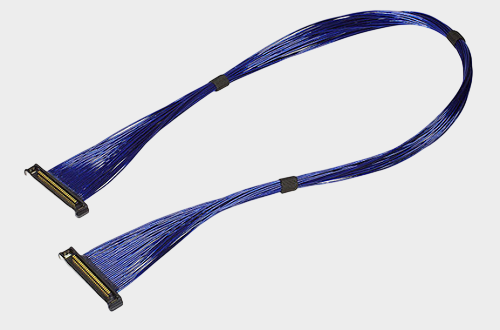
How does a super-fine coaxial cable bundle reduce interference? From shielding structure to signal integrity
High-speed signals may be affected by nearby high-speed lines, power switch noise, and external electromagnetic environments during internal transmission in equipment, resulting in crosstalk, waveform distortion, or signal integrity issues. I-PEX 82189-100B-02-D 30P high-speed signal transmission ultra-thin coaxial cable alternative
The ultra-fine coaxial cable bundle can transmit how much data in one second? The key is to look at the system and signal design.
In high-speed electronic devices, the data transmission speed not only depends on the chip and motherboard, but is also closely related to the signal integrity of the internal cable harness. Extremely thin coaxial cable harnesses use a central conductor, insulation layer, and external shielding structure, which can be used for high-speed signal transmission and also meet the wiring needs in narrow spaces. For engineers, when choosing extremely thin coaxial cable harnesses, they need to pay attention to not only the wire diameter and length, but also comprehensively consider the characteristic impedance, signal frequency, grounding and shielding design, connector performance, and the matching degree between the cable harness and the system interface.
So, how much data can a super-fine coaxial cable bundle transmit in one second? The answer is not fixed. The I-PEX CABLINE®-SS series documentation introduces high-speed connection capabilities for applications up to 16 Gbps/Lane, while also listing relevant transmission standards for reference. However, this does not mean that any cable bundle using this series of connectors can directly reach this speed; actual performance also depends on specific cable material, pin definition, routing, transmitter and receiver chips, and overall system verification results. For engineers, the correct selection method is not just to look at a "Gbps" number, but to confirm whether the cable bundle can meet the target interface's speed, impedance, and signal integrity requirements.
Focus on 50Pin, 100MM specification: wire AWG and connector are equally important
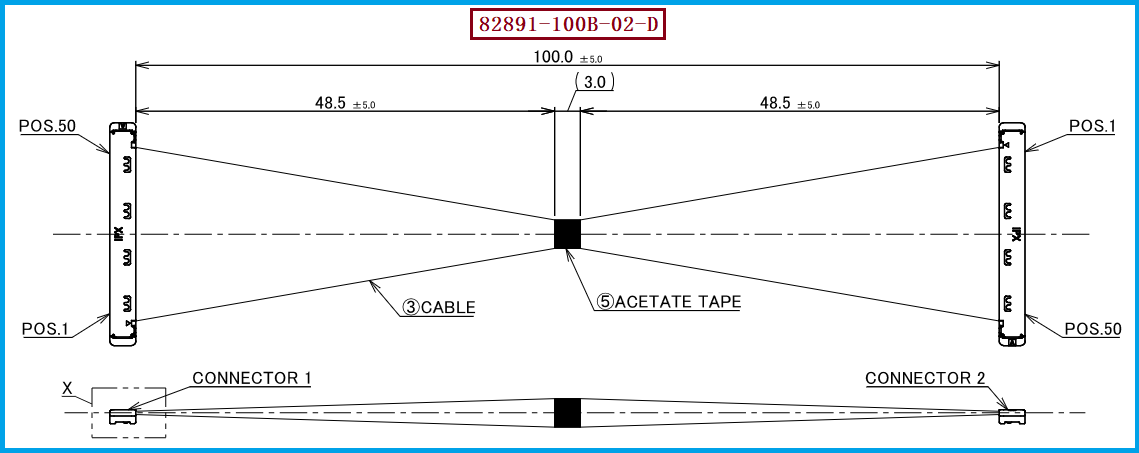
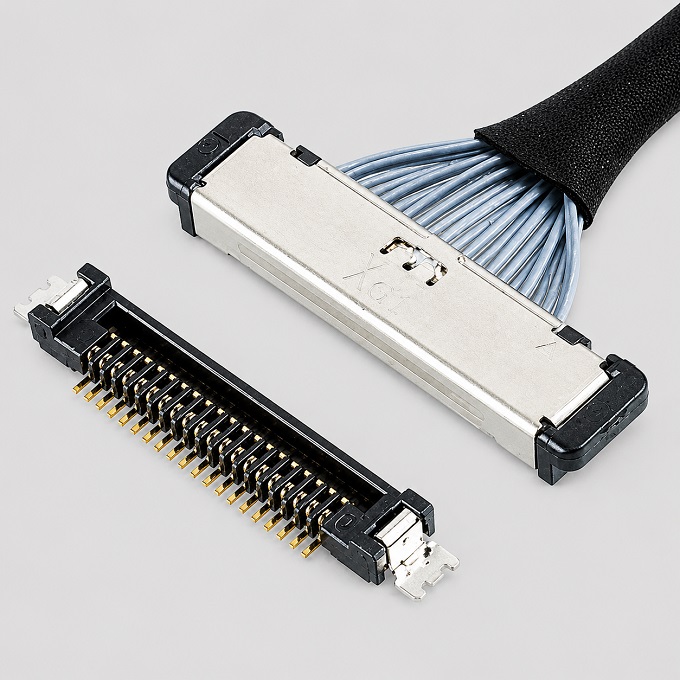
This article introduces the target product model I-PEX 82891-100B-02-D, with a cable length of 100MM, and the connector model used at the cable end is 20373-R50T-06. According to the I-PEX CABLINE®-SS series information, 20373-R50T-06 corresponds to 50Pin Plug Housing (male connector shell), which should be part of a complete cable assembly along with the cable, termination process, and related accessories, rather than considering the connector shell alone as a complete cable component.
The AWG specification of wire is an important parameter in engineering selection. The smaller the AWG value, the larger the conductor wire diameter is usually represented; however, the finer the wire diameter is not always better, as it still needs to be selected comprehensively based on signal type, impedance, space, bending conditions, and electrical performance. The CABLINE®-SS series catalog lists extremely fine coaxial cable specifications such as AWG 40, and demonstrates a 40Pin test example using 40Ω, 100mm wire material. It should be noted that this example is not a direct test report for the 50Pin model described in this article, and therefore, it cannot be concluded that the actual speed or impedance of 82891-100B-02-D is necessarily the same. During project development, it is recommended to confirm AWG, impedance, wire sequence, and shielding termination method according to the original drawings, wire material specifications, and whole machine test requirements before performing sample verification.
Three, selection and compatibility and alternative solutions reference and suggestions
For R&D engineers, it is important to first confirm key conditions such as the mainboard side connector, pin count, cable length, wire sequence definition, wire material AWG, and characteristic impedance during selection. Then, verify the internal wiring space, bending paths, and signal rate requirements of the equipment. For procurement personnel, it is recommended to focus on verifying the product part number, connector model, consistency between samples and mass production specifications, delivery time, quality inspection items, and the supplier's process control capabilities. Even if the product name or connector model is the same, it should not be assumed to be fully compatible based on appearance alone; wire sequence, termination method, wire material parameters, and actual matching status may all affect the final usage effect.
If the project is looking for a compatible alternative for I-PEX 82891-100B-02-D, the original product drawings and actual samples can be used as a basis for verification. Each item should be confirmed, including the 50Pin configuration, 100MM length, 20373-R50T-06 connector shell, wire AWG, impedance, wire sequence, and key dimensions. The alternative results should be verified through plug-and-play coordination, conduction, short-circuit, size, and high-speed signal testing. Our company can provide a compatible alternative cable assembly solution for I-PEX 82891-100B-02-D. We can evaluate, sample, and manufacture extremely thin coaxial cable assemblies based on the customer's provided drawings, samples, and technical requirements. Specific AWG specifications, wire sequence, and performance indicators must be determined during the project confirmation phase based on original documents and testing requirements to ensure that the alternative solution meets the actual equipment needs.
Four, for engineering and procurement needs: use verification results to support stable import
Extremely thin coaxial cable bundles, although with a small volume, have high requirements for the manufacturing process, including stripping, coaxial structure treatment, terminal welding or termination, shielding treatment, wire sequence control, and dimensional consistency. For engineering teams, a reliable cable scheme helps reduce uncertainties in high-speed signal debugging; for procurement teams, products with clear specifications, clear inspection standards, and continuous stable supply help control import risks and subsequent maintenance costs. Therefore, in the process of cable replacement development, it is recommended to first conduct sample evaluation, then complete electrical, mechanical, and system-level verification according to project requirements, and maintain consistency of key materials, processes, and inspection standards in the mass production stage.
Our company specializes in the production and manufacturing of ultra-fine coaxial cable assemblies, and can provide customized manufacturing services based on customers' specified product models, connector configurations, cable lengths, and material specifications. For the target configuration of I-PEX 82891-100B-02-D, 100MM, cable end connector 20373-R50T-06, we can cooperate with customers to carry out drawing confirmation, sample production, and specification verification, helping engineers assess compatibility and also providing purchasing personnel with compatible alternative supply solutions. The actual delivery specifications and performance are based on the technical documents, sample verification, and inspection results confirmed by both parties.

The transmission capacity of a very fine coaxial cable bundle in one second can be how many G of data, which cannot be determined solely by the cable bundle model or connector series name, but requires an evaluation of the wire material AWG, characteristic impedance, connector, wire sequence, and the overall signal design of the entire machine. For the I-PEX 82891-100B-02-D 50Pin, 100MM target cable bundle, paired with the wire-end connector 20373-R50T-06, engineers should focus on specification matching and actual performance verification, while purchasers should pay attention to compatibility confirmation, quality control, and stable supply.
I am【7A Electronic Network】Professional custom production of extremely thin coaxial cable assemblies and matching connectors, terminals, and board-to-board connectors. If you need technical evaluation or project cooperation, please contact: Yin Manager18013280527 (WeChat number).
“Without the consent or authorization of this site, no one shall reproduce, reprint, distribute, cite, change, broadcast or publish the content in whole or in part in any form, nor shall there be any other violation of the copyright of this site.