


Categorization:Harness Component
Precision connection, facilitating the design of high-density electronic devices and micro-imaging systems
With the continuous development of electronic devices towards miniaturization, high resolution, and high-speed signal transmission, the internal wiring harnesses of devices are facing more stringent requirements for space, signal integrity, and assembly reliability. Especially in miniature cameras, medical endoscopic imaging modules, industrial vision equipment, and compact electronic products, how to achieve stable multi-channel signal transmission in limited space has become a key issue that engineers need to consider during product design. The extremely thin coaxial cable harness, consisting of a central conductor, insulating medium, outer shielding layer, and outer sheath, helps control transmission impedance, reduce the impact of external electromagnetic interference on signals, and support high-density, multi-channel wiring. For devices that need to transmit image data, in addition to focusing on the performance of the camera sensor itself, attention should also be paid to the complete signal chain composed of cables, connectors, and termination structures. The 82889-100B-02-D extremely thin coaxial cable harness based on the I-PEX CABLINE®-SS series, using 40 cores of 40AWG extremely thin coaxial cables, and equipped with the 20373-R40T-06 cable termination connector, can serve as a reference object for engineers to evaluate 40 Pin miniature connection solutions. It should be noted that the actual high-speed performance still depends on the wire impedance, termination technology, matching connectors, and overall test results.
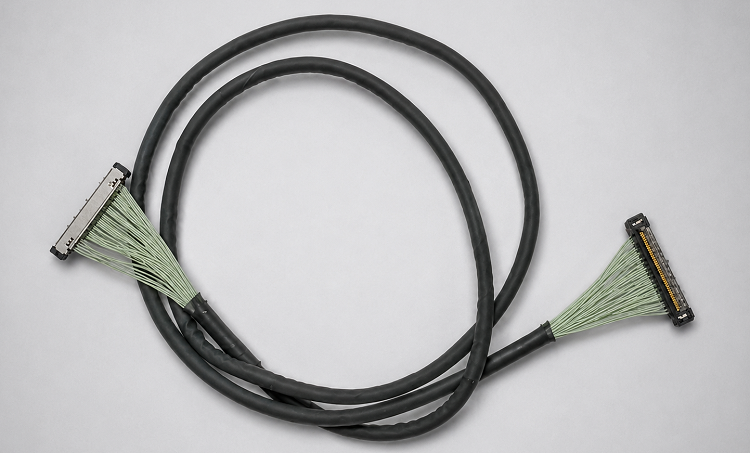
Why do medical endoscopes use extremely thin coaxial cables? The dual demand of small space and high-quality image transmission
Medical endoscopes require transmitting image signals collected by the front-end miniature camera module to the back-end processing system, while also considering the instrument size, internal wiring space, bending paths, and work reliability. With the development of high-definition imaging and higher resolution image applications, signal channels not only need to be as compact as possible but also need to have appropriate impedance control and anti-interference capabilities. Traditional multi-core wire bundles can meet some basic connection needs, but when the number of channels increases and the device space further shrinks, the overall volume of the wire bundle, the complexity of wiring, and the control of interference between different signals may become design challenges. Extremely thin coaxial cables, through independent coaxial shielding structures, help reduce external interference and the risk of cross-talk between channels; their thin diameter features also facilitate the arrangement of multiple signal paths in narrow spaces. Therefore, extremely thin coaxial cables are often used in miniature cameras, endoscope imaging modules, and other imaging devices with limited space. However, the cable itself cannot solely determine the final image quality; engineers also need to comprehensively evaluate transmission loss, impedance matching, shielding termination, bending radius, and dynamic bending life. Medical equipment projects should also verify cleanliness, disinfection, sterilization, material compatibility, and regulatory requirements according to specific uses; it cannot be assumed that the product meets the conditions for medical device use simply by using extremely thin coaxial cable bundles.
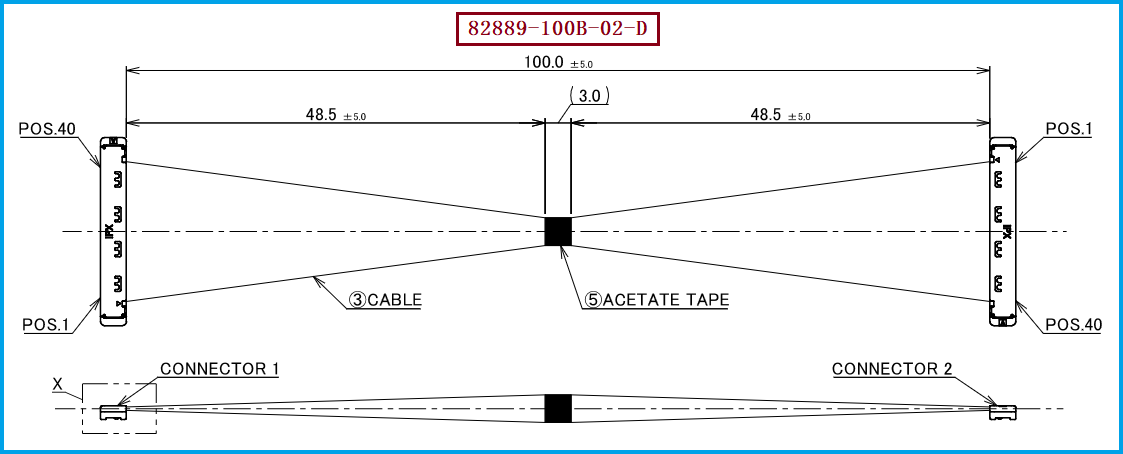 Three: Focus on 40AWG wire material and CABLINE®-SS connection structure, taking into account design evaluation and procurement management
For the project to evaluate I-PEX 82889-100B-02-D, engineers and purchasing personnel should first clarify the number of cores, wire length, wire sequence, connector compatibility, and electrical requirements of the cable. The corresponding reference configuration for this model is a 40 Pin coaxial cable with a length of 100 mm, featuring ultra-thin wire, with wire specifications of 40AWG. The original factory sample material number is I-PEX 82889-100B-02-D; the main model of the wire-end connector is 20373-R40T-06, and the metal cover, matching board-end connector, and termination structure should be confirmed in conjunction with the original factory drawings. 40AWG wire material has a finer conductor specification and is suitable for designs with high requirements for wiring space, but the actual outer diameter, shielding structure, characteristic impedance, attenuation, and bend performance still need to be based on the specific wire material specification sheet. When selecting for purchase, it is recommended to integrate the original factory material number, drawing version, connector model, length tolerance, wire sequence definition, and inspection requirements into the technical documents to avoid judging product compatibility solely based on "40 Pin" or "40AWG". For high-speed image links, a clear acceptance standard should be established through conductive and short-circuit checks, insulation and voltage resistance tests, dimensional inspection, and necessary insertion loss, return loss, crosstalk, and actual equipment image transmission verification. Our company focuses on the production and manufacturing of ultra-thin coaxial cables and can carry out structural evaluation, process matching, and sample verification based on the customer's drawings, samples, and technical requirements. Our company can provide: I-PEX 82889-100B-02-D compatible alternative cable solutions, assist customers in evaluating the feasibility of alternatives, optimize purchasing choices, and provide technical support for subsequent mass production. The specific level of compatibility is determined by the results of sample testing and customer整机 verification.
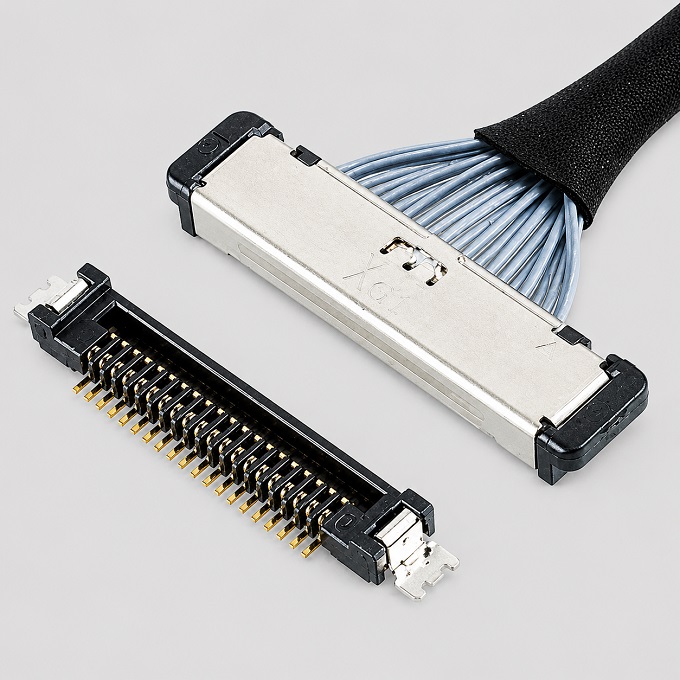
Four: Selection, Compatibility, and Alternative Solutions Reference and Recommendations
When evaluating compatible alternatives for I-PEX 82889-100B-02-D, it is recommended to prioritize the original engineering drawings and physical samples as the benchmark. Confirm the 40 Pin terminal arrangement, the mating connector orientation at both ends, the 100 mm wire length and its tolerance, the complete specifications of the 40AWG ultra-fine coaxial cable, as well as the wire sequence mapping and central fixation method required in the original drawing. Special attention should be paid to the 20373-R40T-06 as the main model of the wire end connector, which cannot represent the entire connector assembly alone; during alternative development, it is also necessary to confirm the models and dimensions of components such as the metal cover and matching board end connectors. If the project is for medical endoscopes or other miniature imaging equipment, further verification of actual signal interfaces, impedance targets, operating frequencies, wire harness dynamic bending conditions, material requirements, and relevant verification specifications is required. Purchasing personnel may request suppliers to provide samples, key dimension reports, wire sequence continuity records, and electrical test results, and compare them with the original factory samples during the design verification stage. If further cost reduction, improved delivery flexibility, or seeking a second supply source is needed, it is advisable to start with compatible cable harness solutions of the same specification, wire sequence, and length, and then decide whether to move to mass production based on actual verification results. Our company can provide support around the I-PEX 82889-100B-02-D compatible alternative cable harness solutions, working with customers to review drawings, trial production of samples, matching of wires and connectors, confirmation of termination processes, and necessary performance tests, helping engineering teams reduce the risk of introduction and providing the purchasing team with more flexible supply options. Any alternative solution should be based on mechanical, electrical, and application verification, and cannot be solely based on appearance similarity or model correspondence as the basis for complete compatibility.
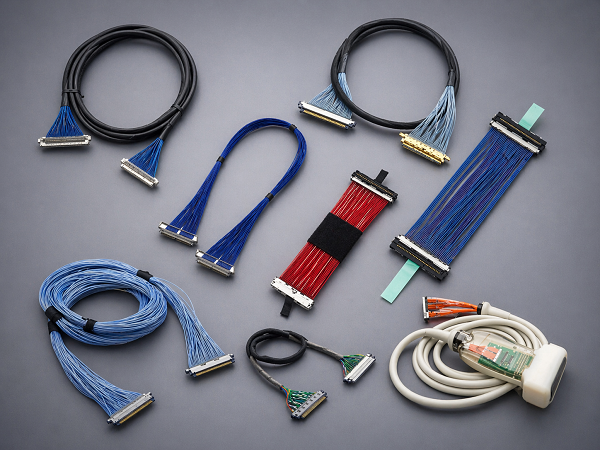
I-PEX 82889-100B-02-D is a noteworthy 40 Pin, 100 mm ultra-thin coaxial cable assembly reference model, with its 40AWG wire material and CABLINE®-SS series miniature connector structures, providing a reference for high-density signal connections and imaging equipment with limited space. The core reason for the medical endoscope to adopt ultra-thin coaxial cables lies in the need to balance multi-channel wiring, signal integrity, and equipment miniaturization within limited space. For engineers and purchasers looking for alternative supply solutions, the key is not only to confirm the cable assembly part number and connector model but also to systematically check the wire sequence, dimensions, impedance, termination process, and overall application requirements of the entire machine.
I am【7A Electronic Network】Professionally providing mature alternative solutions for high-speed ultra-fine coaxial cable assemblies and connectors, as well as engineering and product support. If you have any needs, please contact: Manager Zhang.18913228573 (WeChat number).
“Without the consent or authorization of this site, no one shall reproduce, reprint, distribute, cite, change, broadcast or publish the content in whole or in part in any form, nor shall there be any other violation of the copyright of this site.