


Categorization:Harness Component
Part 1: 14Pin, AWG40 and 1-1 Wire Sequence: Product Specification Analysis for Engineers and Purchasers
In the internal spaces of laptops, ultra-thin display devices, high-speed camera modules, and other space-limited electronic equipment, high-speed signal cable harnesses not only need to meet electrical performance requirements but also need to consider connector size, wire diameter, wiring space, and consistency in mass production. This introduction is about the I-PEX CABLINE-SS 14Pin ultra-thin coaxial cable assembly, product code I-PEX 83011-100B-01-D, with engineering drawings corresponding to a cable length of approximately 200 mm. It uses 14 Micro-Coaxial Cables, wire specifications of AWG #40, 50Ω, blue ultra-thin coaxial wire, and both ends are equipped with corresponding CABLINE-SS 14Pin connector structures. The wire positions are defined as 1-1, meaning Pin 1 corresponds to Pin 1, Pin 2 to Pin 2, and so on up to Pin 14. For engineers, these parameters directly relate to PCB terminal interface matching, signal path design, and overall wiring; for purchasers, product code, Pin count, wire length, AWG specification, impedance, and wire sequence are essential basic conditions for supplier quotation, sample confirmation, and alternative material verification. The cable assembly uses wire-end connector model 20373-R14T-06, which belongs to the CABLINE-SS 14Pin Plug Housing. According to I-PEX official data, CABLINE-SS uses a 0.4 mm pitch, vertical right-angle insertion and extraction structure, and supports AWG40 Micro-Coaxial Cable.
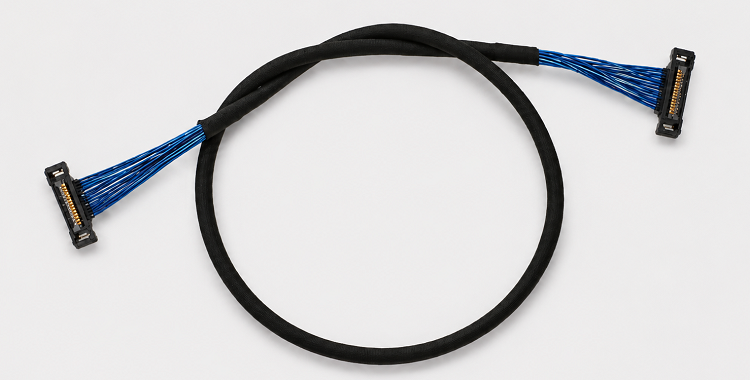
Why does the thickness of the insulating layer affect the impedance stability of ultra-fine coaxial cables? — A crucial factor that cannot be ignored in engineering design
For high-speed ultra-fine coaxial cables, the insulating layer not only serves the functions of "insulation" and "protection," but also participates in the formation of the electrical parameters of the transmission structure. Simply put, the characteristic impedance of the coaxial cable is related to the size of the central conductor, the dielectric properties of the insulating material, the geometric dimensions of the insulating layer, and the relative position between the shielding layer and the central conductor. When the thickness of the insulating layer changes, the distance between the central conductor and the external shielding structure also changes accordingly, which may cause changes in the capacitance per unit length, electric field distribution, and characteristic impedance. For ultra-fine coaxial cables, due to their small overall size, even minor manufacturing fluctuations in the size of the insulating layer may have a more significant impact on impedance consistency. Therefore, in the manufacturing process of ultra-fine high-speed cables such as AWG #40, 50Ω, it is necessary to comprehensively control the dielectric constant stability of the insulating material itself, the uniformity of the insulating layer thickness, roundness, and concentricity between the central conductor and the shielding layer. For engineers, what truly needs to be concerned with is not simply pursuing "the thicker the insulating layer, the better" or "the thinner, the better," but matching the design according to the target impedance, cable outer diameter, material dielectric properties, and connector structure; for purchasers, it should be concerned with whether the supplier can continuously and stably control these key dimensions, rather than just comparing the appearance of the cable and单纯的价格. It should be emphasized that the relationship between the thickness of the insulating layer and the impedance described in this article belongs to the general transmission line principle of ultra-fine coaxial cables, and is not the specific insulating layer thickness parameter published in the I-PEX 83011-100B-01-D drawing.
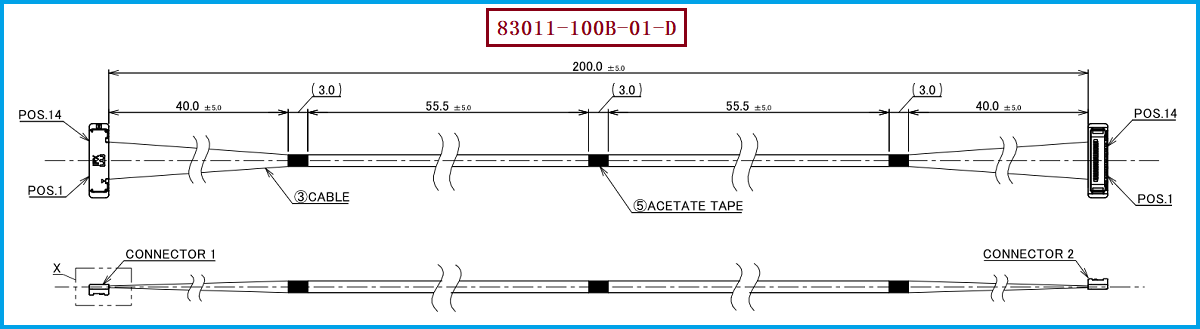
Why is consistency in the manufacturing of ultra-thin coaxial cable bundles important from the perspective of high-speed signal integrity for 83011-100B-01-D?
For such ultra-fine coaxial cable assemblies as I-PEX 83011-100B-01-D with 14 pins, the engineering value is not only reflected in "being able to connect both ends," but more importantly, each channel must maintain stability under specified structural, wiring, and electrical conditions. This model uses AWG #40, 50Ω Micro-Coaxial Cable and is connected in a 1-1 manner, so in the actual manufacturing process, attention must be paid to wire impedance, length consistency, terminal stripping and crimping/wiring quality, connector assembly position, cable assembly fixing, and overall finished product dimensions. I-PEX positions the CABLINE-SS series itself as high-speed, miniaturized ultra-fine coaxial connectors, and the official data of the series high-speed performance demonstration uses AWG40, 45Ω Micro-Coaxial Cable, with a 100 mm length test condition, positioning the product for the highest 16 Gbps/Lane high-speed data transmission applications; these are official performance data of the connector series and do not equate to the independent measured rate of the specific cable assembly part number 83011-100B-01-D. Therefore, when carrying out domestic substitution or compatible substitution, a more reasonable engineering approach is to base it on the original mechanical dimensions, Pin definition, wire specifications, and impedance requirements, and then verify the conductivity, insulation, impedance, and high-speed signal integrity through actual samples. For procurement departments, this also means that when selecting substitute suppliers, in addition to focusing on the quotation, attention should also be paid to whether the supplier has the ability to mass manufacture AWG40 ultra-fine coaxial cables stably and whether they can confirm the samples according to the original model's structure and specifications. Our company can provide: I-PEX 83011-100B-01-D compatible substitution cable assembly solutions, which can be developed and manufactured according to the customer's provided drawings, samples, or specific application requirements, corresponding to the key specifications such as 14Pin, AWG40, 50Ω, 200 mm, and 1-1 wiring sequence, providing compatible substitution options for engineering verification and bulk procurement.
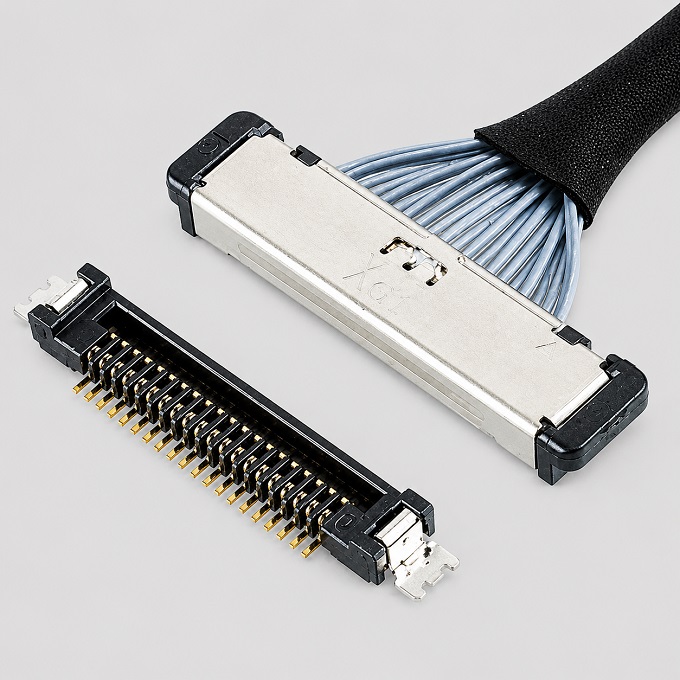
Four, selection and compatibility, as well as reference and suggestions for alternative solutions: from model confirmation to bulk procurement
If engineers or purchasing personnel are looking for a compatible or alternative product for I-PEX 83011-100B-01-D, it is recommended to first confirm that the connector platform and pin count are consistent, and then to check the cable specifications, impedance, length, and wire sequence. The key identification combination for this model can be summarized as CABLINE-SS 14Pin + 20373-R14T-06 + AWG #40 + 50Ω + 200 mm + 1-1. I-PEX official data indicates that the CABLINE-SS series offers specifications of 10, 14, 20, 30, 32, 35, 40, 50 pins, etc., and the 14Pin Plug Housing includes 20373-R14T-06. Therefore, when selecting alternatives, it is not sufficient to simply match by "14Pin ultra-thin coaxial cable assembly" but to further confirm that the connector model and specific cable configuration correspond. For purchasing personnel, if there are issues with lead time, price, MOQ, or supply stability in the original supply chain, I-PEX 83011-100B-01-D can be used as the target model and "one-to-one" specification confirmation can be conducted with alternative suppliers; for engineers, it is recommended to focus on verifying mechanical fit, Pin-to-Pin wire sequence, conduction and insulation performance, impedance consistency, and actual high-speed signal performance during the alternative sample stage before deciding whether to proceed with bulk procurement. Our ultra-thin coaxial cable assembly manufacturing capabilities can conduct compatible alternative development for this model, and our company can provide I-PEX 83011-100B-01-D compatible alternative cable assembly solutions to help customers with sample verification and subsequent mass production connection around existing equipment structure and interface requirements.
83011-100B-01-D is a very thin coaxial cable assembly product with core features including 14Pin, AWG #40, 50Ω, 1-1 wire sequence, and CABLINE-SS connector structure; in high-speed, miniaturized electronic equipment, the stable cable structure and manufacturing consistency are as important as the connector itself, and the thickness and uniformity of the insulation layer are one of the key factors affecting the stability of the coaxial transmission structure. For engineers and procurement personnel who need to find reliable alternative suppliers, moving from "model correspondence" to "specification correspondence, structure correspondence, and performance verification correspondence" is a more secure solution for the compatibility and alternative of very thin coaxial cable assemblies.
I am【7A Electronic Network】We specialize in providing customized and compatible alternative services for high-speed ultra-thin coaxial cable assemblies such as eDP, MIPI, USB3.X/4, LVDS, etc. If you need technical support, please contact: Manager Yin.18013280527 (same number on WeChat).
“Without the consent or authorization of this site, no one shall reproduce, reprint, distribute, cite, change, broadcast or publish the content in whole or in part in any form, nor shall there be any other violation of the copyright of this site.