


Categorization:Harness Component
Ultra-thin, High-Density, and High-Speed Signal Transmission: Product Features of I-PEX 82877-100B-02-D
In laptops, industrial cameras, AI vision devices, precision display modules, and miniaturized intelligent devices, connectors and cables often need to meet design requirements of "smaller space, higher signal speed, and more complex structure" simultaneously. The I-PEX CABLINE®-CX II With Cover is a miniature ultra-thin coaxial connector solution specifically designed for such applications. According to the product information, this series adopts a 0.25mm Contact Pitch and 40Pin structure, paired with Micro-Coaxial ultra-thin coaxial wires, and utilizes mechanical locking tabs and EMI shielding structures. The mating height of the connector is approximately 0.83±0.17mm, with the maximum covered height at 1.00mm, capable of meeting the internal connection needs of high-density, miniaturized devices. The product literature lists a reference transmission capability of 5Gbps/lane NRZ, and involves high-speed signal applications such as USB 3.1 Gen1, V-by-One HS, HDMI, eDP, and MIPI.
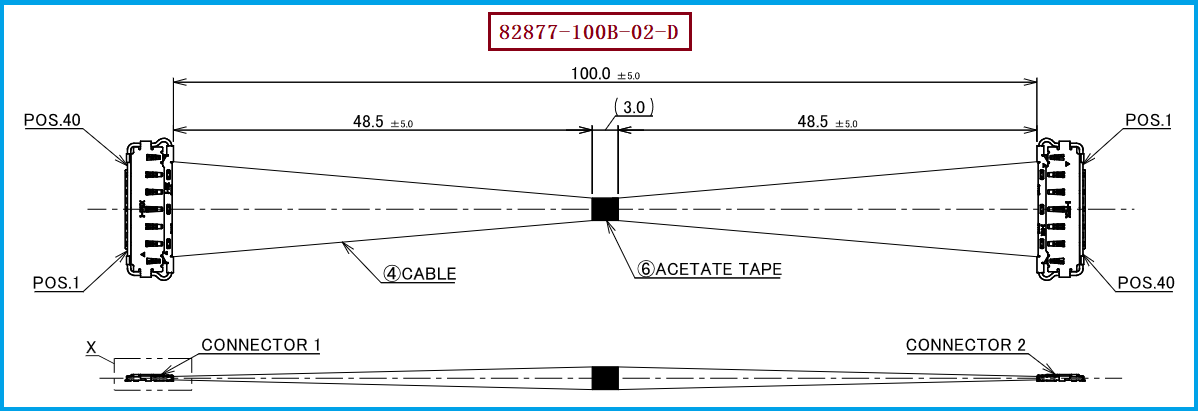
This article focuses on the extremely fine coaxial cable assembly model I-PEX 82877-100B-02-D, which has a structure of 40Pin, AWG46 Micro-Coaxial extremely fine coaxial cable, and a length of 100mm, using the 1-N Wiring definition. The cable end connector corresponds to 20974-040T-01, and the connector is of the CABLINE-CX II series structure with a 40PIN, 0.25MM Pitch. For engineers, this means that when conducting replacement design, they must not only pay attention to the surface parameters such as "40 cores, 100mm", but also confirm the connector model, Pitch, wire diameter, impedance, Pin Assignment, cable assembly, and shielding and fixing processes; for purchasers, it is necessary to confirm whether the replacement product can meet the original project's verification requirements in terms of mechanical dimensions, connector matching, wire sequence, and electrical performance. According to the I-PEX engineering drawings you provided, this model uses AWG46, 50Ω Micro-Coaxial Cable, with a rated voltage of 30V, a maximum working temperature of 80°C, and has clear requirements for voltage resistance, leakage current, and insulation resistance. Therefore, the replacement cable cannot be simply understood as a common 40-core cable, but should be manufactured and verified with targeted extremely fine coaxial cable specifications in accordance with the original engineering specifications.
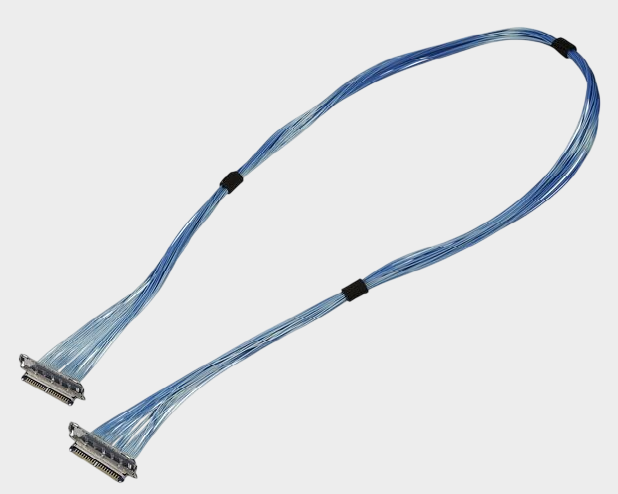
The ultra-fine coaxial cable束 has what "secret applications" in drones? The truly crucial part may not be the wire you see.
The internal space of drones is limited, yet it integrates high-definition cameras, tripods, image processing, electronic servos, communication, positioning, and various intelligent payloads. Many high-speed data actually need to be transmitted within an extremely small space. Particularly, the tripod camera, there is both high-speed image data transmission and control, monitoring, and other signal interactions between the camera and the body, so the cables need to be as thin and light as possible and be able to adapt to the spatial layout of the moving parts. Public information shows that some of DJI's professional imaging equipment has already adopted ultra-thin coaxial cables for high-speed connections between the body and the camera; for example, the Ronin 4D Flex public information explicitly mentions that it uses 2 meters of ultra-thin coaxial cable between the camera and the main body for high-speed image and control signal transmission. DJI's drone payload development information also shows that there are coaxial cables and high-speed data interfaces between the flight platform, tripod, and payload, such as E-Port, SkyPort, and other connection schemes, which are used for data connections between payload devices.
Therefore, from the perspective of engineering applications, extremely fine coaxial cables may be responsible for some "not easily visible" connection tasks in drones. For example, inside the gimbal camera, extremely fine coaxial cables can be used for high-speed signal connections between image sensors, camera modules, and backend processing circuits; in composite payloads such as visible light, infrared, and thermal imaging, they may be used for high-speed data channels between different functional modules; and in miniaturized transmission and visual processing modules, extremely fine coaxial cables are also suitable for high-speed signal connections with high requirements for space and EMI control. It should be emphasized here that the above is a typical engineering application direction combined with public drone payload interface data and the characteristics of Micro-Coaxial products, and does not mean that I-PEX 82877-100B-02-D has been publicly specified and adopted by a specific drone manufacturer. For drone design engineers, the true value of this kind of cable lies in its ability to balance high-density wiring, signal transmission, flexibility, and structural miniaturization within limited space, which is highly relevant to the design requirements of drone gimbals, cameras, and intelligent payloads. At the same time, the length, loss, shielding, and wiring method of射频/ high-speed coaxial cables will also affect the performance of high-frequency signals, so actual projects still need to be verified based on specific frequencies, link lengths, and system test results.
Three, selection, compatibility, and alternative solution references and suggestions: engineers focus on matching, procurement focuses on substitutability
If the customer is looking for a compatible alternative ultra-thin coaxial cable assembly for the I-PEX 82877-100B-02-D, it is recommended to first confirm according to the logic of "Connector - Number of Pairs - Pitch - Cable Material - Length - Wire Sequence - Electrical Performance - Mechanical Structure", rather than simply searching for products with similar appearance based on the model name. For the products in this article, the core matching relationship is: I-PEX 82877-100B-02-D + 40Pin + AWG46 Micro-Coaxial + 100mm + 1-N Wiring + 20974-040T-01 cable end connector. The connector is 40PIN, 0.25MM Pitch, which is a key mechanical interface condition to be confirmed during alternative development; the original engineering drawing also clearly specifies the structure and process information such as AWG46, 50Ω, cable length, tolerance, Bonding, and Acetate Tape.
For purchasers, if the project originally uses I-PEX 82877-100B-02-D, it is recommended to prioritize 1:1 specification confirmation with the substitute supplier according to the original model's physical or engineering drawings. The focus should be on confirming whether the connector is truly compatible, if the 40Pin arrangement is consistent, if the two-end Pin Assignment is consistent, if the electrical parameters of the AWG46 ultra-thin coaxial cable meet the requirements, and if the size and bending status of the 100mm cable assembly meet the assembly space. For engineers, it is suggested to further verify impedance, insertion loss/signaling integrity, insulation resistance, voltage resistance, connector fit, tensile strength, bending life, and the actual system's high-speed signal performance. It should be particularly noted that the same CABLINE-CX II With Cover platform in the I-PEX documentation also exists in different lengths and with different wiring definitions such as 1-N and 1-1 in Sample Harnesses, so one cannot simply consider different models interchangeable just by seeing "40Pin + AWG46".
Our company can provide compatible and alternative cable harness solutions for I-PEX 82877-100B-02-D, catering to customers who need domestic alternatives, supply chain options, sample verification, and bulk purchasing. We can match and develop for extremely thin coaxial wire, 40Pin connectors, wiring sequence, length, and cable harness forming structure based on the original model, samples, or engineering specifications provided by the customer. For projects using 20974-040T-01, 40PIN, and 0.25MM Pitch connectors, targeted compatible and alternative solution designs can also be developed around the actual assembly environment. For purchasing parties, this approach can further transform "searching for the same model product" into "searching for compatible and alternative suppliers that meet the original engineering specifications"; for the research and development end, it can more directly enter the sample proofing, size confirmation, signal testing, and overall system verification process.
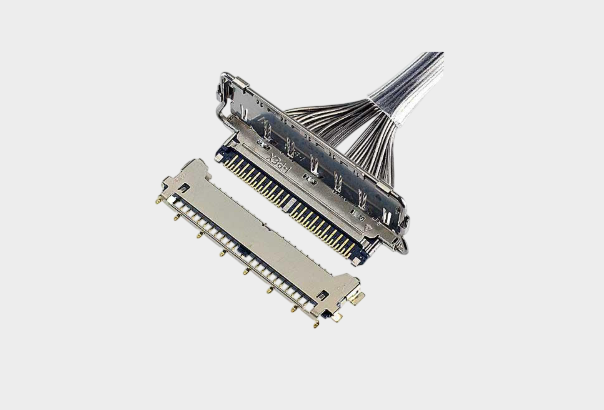
From drones to industrial vision, ultra-fine coaxial cables are becoming an important connection solution for small high-speed devices.
With the continuous development of drones, industrial cameras, AI vision equipment, and intelligent payloads towards miniaturization, lightweighting, and high data volume, the wire harness is no longer just a simple "conductor", but has become a key component affecting the internal space, signal integrity, and reliability of the device. Drone gimbals need to perform multi-axis motion within limited spaces, while cameras and payloads need to transmit an increasing amount of image data, making fine wire diameter, high density, and high-speed signal connection schemes increasingly valuable in practical engineering. Public data shows that professional drone platforms have established various high-speed connection methods around gimbals, cameras, and third-party payloads, including coaxial cables; at the same time, industrial drones are widely used in patrol tasks such as power line inspections, wind turbines, bridges, communication facilities, and solar panels, which have put forward continuous data connection requirements for high-definition vision, thermal imaging, and other sensing payloads.
For engineers, choosing an extremely thin coaxial cable assembly requires comprehensive judgment from four aspects: "signal, space, structure, and reliability"; for procurement personnel, it is necessary to pay attention to model correspondence, connector matching, delivery time, sample verification, and batch consistency. The I-PEX 82877-100B-02-D represents a 40Pin, AWG46, 100mm extremely thin coaxial cable assembly solution, which is a typical small high-density connection product. Especially in projects that require using the 20974-040T-01 wire-end connector, 40PIN, 0.25MM Pitch, through compatibility and substitution development by professional extremely thin coaxial cable assembly manufacturers, new solutions can be provided for research and development verification and supply chain selection.

I-PEX 82877-100B-02-D is a 40Pin ultra-thin coaxial cable assembly with clear engineering specifications. Its core features include AWG46 Micro-Coaxial ultra-thin coaxial cable, 50Ω, 100mm cable length, 40Pin connector structure, and 0.25MM Pitch cable end connector 20974-040T-01. This type of product is not only suitable for traditional notebook, display, and industrial vision equipment, but its "ultra-thin, high-density, high-speed, and flexible" characteristics also make it have engineering potential for applications in drone gimbals, intelligent vision payloads, and small high-speed data modules. For R&D and procurement personnel looking for I-PEX specifications or compatible alternative solutions, mechanical compatibility, electrical matching, consistent wiring sequence, consistent structure, and actual system verification can be used as core judgment criteria. Our company can provide I-PEX 82877-100B-02-D compatible alternative cable assembly solutions, develop samples and match specifications according to customers' actual product structure and technical requirements, and provide professional support for the domestic substitution and supply chain backup of ultra-thin coaxial cable assemblies.
I am【7A Electronic Network】, Provide structural optimization and signal consistency evaluation services and product solutions for high-speed ultra-fine coaxial cable assemblies according to requirements. For more information, please contact: Manager Yin18013280527 (WeChat number).
“Without the consent or authorization of this site, no one shall reproduce, reprint, distribute, cite, change, broadcast or publish the content in whole or in part in any form, nor shall there be any other violation of the copyright of this site.