


Categorization:Harness Component
What should engineers pay attention to first when selecting a 40PIN ultra-thin coaxial cable assembly for high-speed devices?
Inside laptops, display modules, camera modules, AR/VR devices, and other high-density electronic devices, cables often need to complete high-speed signal connections within limited spaces. Therefore, issues such as "is the wire thin enough, is the interface small enough, and is the signal stable after bending" have gradually become the focus of engineers in cable design and selection. The I-PEX CABLINE®-CAL series uses a 0.4mm contact pitch and a horizontal insertion structure. The combination size of the 40PIN specification can reach approximately 24.05mm wide, 5.50mm deep, and a maximum of 0.80mm embedded height, aimed at low space connection applications. The official materials also list specifications such as AWG38, AWG40, AWG42, and AWG44 Micro-Coaxial Cable.
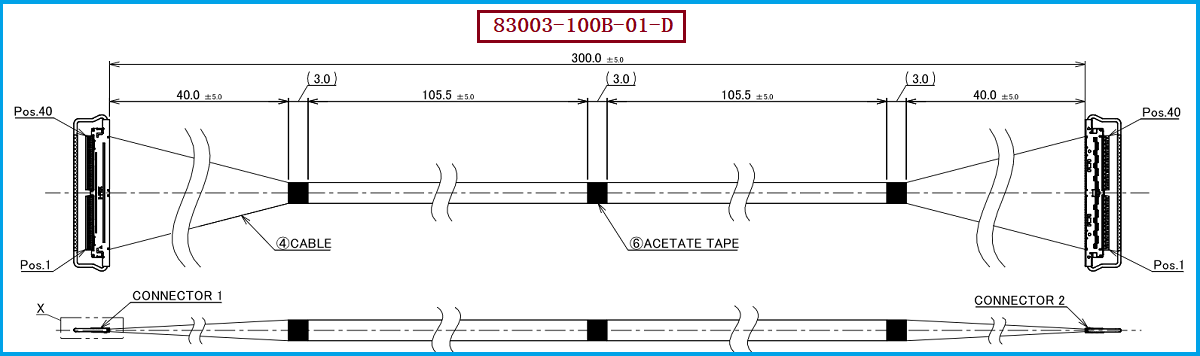
The product introduced this time is I-PEX 83003-100B-01-D, which belongs to the CABLINE-CAL 40PIN Micro-Coaxial Harness, using 40AWG ultra-fine coaxial wire, 300MM in length, and a 1-1 two-end connection structure. The official model information of I-PEX clearly lists 83003-100B-01-D as "40pin micro-coaxial 40AWG L=300mm 1-1" cable harness. The connector models that match this harness are 20777-040T-01, which I-PEX official documents list as CABLINE-CAL 40PIN Plug Housing; for engineers who need to develop replacements, the connector specifications, PIN count, Pitch, wire material AWG, cable length, and two-end connection method need to be confirmed as a complete set, and cannot be judged for direct replacement based solely on the appearance size.
For engineering design, 40AWG does not simply mean "thinner wire diameter." Extremely thin coaxial cables need to simultaneously achieve conductor, insulation layer, shielding structure, and coaxial geometric relationships within limited cross-sectional dimensions. Therefore, changes in the mechanical state of the wire material may also further affect its high-frequency electrical characteristics. Particularly when there are bending, winding, turning, and repeated opening and closing actions inside the equipment, the bending radius and routing method of the cable bundle are worthy of early consideration in the design phase.
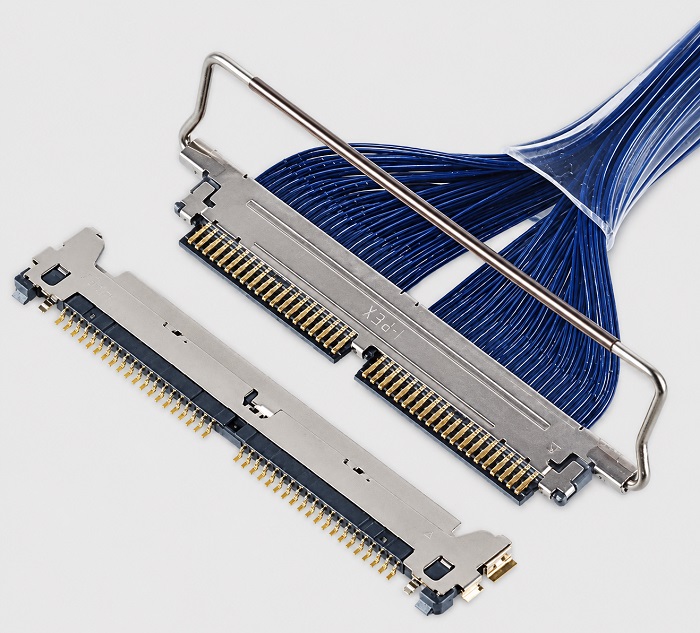
Why does bending a very thin coaxial cable bundle affect signal transmission? Engineers cannot only look at whether "the wire is broken"
Many people may think that as long as the extremely thin coaxial cable does not break, bending will not affect the signal. In fact, for high-speed signal transmission, "conduction" and "signal integrity" are two different levels of concepts. After the extremely thin coaxial cable bundle is bent, the first thing that may happen is a change in the internal geometric structure, such as a change in the relative position of the conductor and the insulating layer, local deformation of the shielding structure, and the coaxial cross-section no longer maintaining an ideal state. These changes may cause the local characteristic impedance to change, thereby causing reflection, insertion loss, or crosstalk problems in the transmission process of high-speed signals. The specific impact extent is related to the cable structure, bending radius, bending angle, bending times, transmission frequency, and actual cable manufacturing process, so it cannot be simply summarized by a fixed value for all extremely thin coaxial cable bundles.
For engineers, this is why high-speed Micro-Coax cable harnesses cannot be tested with just a simple continuity test. One of the high-speed testing conditions provided by I-PEX in the product details of CABLINE®-CAL is AWG #40 Micro-Coaxial Cable, 45Ω, 100mm length, and GSSGSSG Pin Assignment, with which high-speed transmission-related tests are conducted. This indicates that in high-speed applications, the inherent impedance of the cable itself and the signal integrity design are important factors. When the cable harness is subjected to forced bending, localized flattening, or long-term mechanical stress, engineers need to pay further attention to its potential impact on signal integrity.
Therefore, in the actual design of equipment, the bending of extremely thin coaxial cable bundles is not just a matter of "whether it can bend" but requires comprehensive consideration of bending location, bending radius, fixation method, routing space, cable length, and high-speed signal requirements. Especially for cable bundles like the 300MM type that need to be routed over long distances inside the equipment, if there are multiple sharp turns during the design process, it is even more necessary to avoid excessive mechanical stress on the cables through reasonable routing and fixation methods.
From the perspective of purchasing personnel, this point is also very important. When procuring alternative harnesses, if only the keywords "40PIN, 300MM, 40AWG" are used for comparison and the harness structure, connector model, wiring form, and actual signal application environment are ignored, even if the dimensions are superficially the same, problems may arise during assembly or signal performance verification. Therefore, the evaluation of alternative harnesses should be extended from "specification matching" to "application condition matching."
Three, selection and compatibility and alternative solution reference and suggestions: from model matching to complete harness solution matching
For the alternative development of I-PEX 83003-100B-01-D-01, engineers are advised to first confirm the basic structure of the original product: 40PIN, 0.4mm Pitch, 40AWG Micro-Coaxial Cable, 300MM length, 1-1 structure. In the CABLINE-CAL evaluation cable released by I-PEX, the 40PIN 1-1 structure also includes 83001-100B-01-D (100mm), 83002-100B-01-D (200mm), and 83003-100B-01-D (300mm). Therefore, when confirming the alternative model, both length and connection structure are important identification conditions for the model.
In terms of connectors, it is necessary to focus on the structure of 20777-040T-01 and the corresponding 40PIN CABLINE-CAL interface system. The I-PEX official recommended part numbers list the 40PIN Plug Housing 20777-040T-01, as well as the 40PIN Plug Cable Assembly 20728-040T-01, 40PIN Plug Shell 3298-0401, 40PIN Plug Lock Bar 3300-0401, and 40PIN Receptacle 20729-040E-02. Therefore, in actual replacement projects, it is not enough to check the single plastic Housing model; one should also confirm the complete connector components, PCB side interface, and cable assembly dimensions.
For projects with high requirements for signal transmission, attention should also be paid to the actual impedance and signal environment of the original harness. The official high-speed test data of CABLINE-CAL uses AWG40 Micro-Coax, 45Ω, 100mm, and GSSGSSG test conditions, and takes 40Gbps/lane PAM3 as the reference transmission capability; these are reference materials provided by I-PEX for the connector platform, and do not mean that all 300MM harnesses using the CABLINE-CAL connector can directly achieve the same transmission performance in any system. Therefore, the specific replacement projects should still be confirmed based on the actual wire structure, length, Pin Assignment, and system test results.
For procurement personnel, I-PEX 83003-100B-01-D, 40PIN, 40AWG, 300MM, 1-1, 20777-040T-01 can be used as the core identification information for inquiry and technical communication. Further confirmation of harness drawings, connector compatibility, wire impedance, wire exit direction, bending requirements, and sample verification conditions should be carried out. This procurement method is more suitable for substitute applications in high-speed electronic equipment than simply searching for "similar harnesses" based on appearance or length.
Our company can provide: I-PEX 83003-100B-01-D compatible alternative cable assembly solutions. We focus on the production and manufacturing of ultra-fine coaxial cable assemblies and can develop compatible alternative solutions based on the original factory model, drawings, connector specifications, PIN quantity, wire material AWG, length, and actual assembly requirements provided by the customer. We provide engineers with product support for ultra-fine coaxial cable assemblies required for sample verification and mass production introduction. For corporate customers in need of I-PEX 83003-100B-01-D alternative supply solutions, further technical confirmation can be conducted around the specific equipment structure and application requirements.

Four, ultra-fine coaxial cable assembly manufacturing solution for engineering and procurement: Balancing miniaturization, high-speed transmission, and assembly requirements
In terms of the product itself, the core features of I-PEX 83003-100B-01-D can be summarized as: CABLINE-CAL series, 40PIN, 0.4mm Pitch, 40AWG Micro-Coaxial Cable, 300MM, 1-1 structure, and配套使用20777-040T-01 this 40PIN Plug Housing. According to I-PEX official data, CABLINE-CAL has features such as 0.4mm pitch, 0.73±0.07mm mating height, 40PIN specifications, and mechanical lock, and Micro-Coaxial Cable supports AWG38/40/42/44. The official data gives the connector operating temperature range of -40℃~+85℃. For devices that need to complete high-speed signal connections in narrow spaces, this structure can provide a miniaturized connection solution for high-density internal wiring.
For ultra-fine coaxial cable束manufacturing enterprises, what truly needs to be solved is not merely "connecting the wire to the connector", but also includes multiple manufacturing processes such as ultra-fine wire material handling, terminal processing, connector assembly, cable length control, fixation and organization, and product consistency. Especially under ultra-fine specifications such as 40AWG, the cable束 needs to avoid unnecessary mechanical damage during production, assembly, and terminal equipment use, and reasonably design the wire and bending areas in combination with actual applications. For high-speed signal applications, it is further necessary to confirm the matching between the alternative cable束 and the original equipment through actual testing.
For engineers, when selecting compatible replacement harnesses, mechanical dimensions, electrical performance, connector matching, and actual bending and routing conditions should be placed in the same verification system; for procurement personnel, it is important to confirm whether the supplier truly has the stable manufacturing capability for extremely thin coaxial harnesses, rather than just being able to provide a connector or harness that looks similar. Only when product models, connectors, wire specifications, length, and actual application requirements can form a complete match, will the alternative solution be more conducive to subsequent sample verification, trial production, and mass introduction.
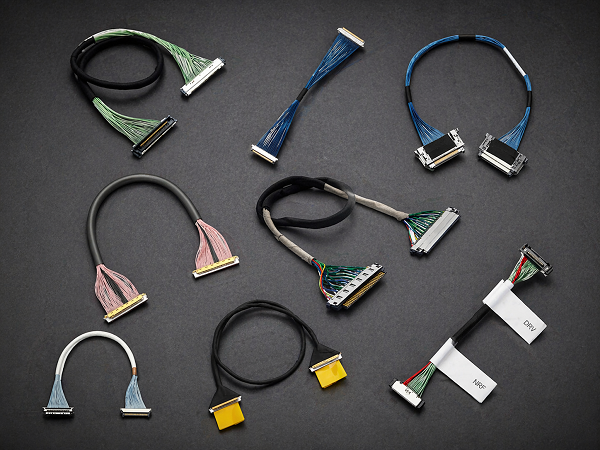
I-PEX 83003-100B-01-D is a 40PIN, 40AWG, 300MM, 1-1 structure CABLINE-CAL ultra-thin coaxial cable assembly. For high-speed signal applications, the ultra-thin coaxial cable assembly may affect the impedance continuity and signal integrity after bending due to changes in the internal geometric structure. Therefore, when engineering design and alternative procurement are considered, attention should not only be paid to "whether it is conductive" but also to the cable structure, bending method, connector matching, and actual high-speed signal verification. Our company can provide I-PEX 83003-100B-01-D compatible alternative cable assembly solutions, focusing on the 40AWG ultra-thin coaxial cable, 40PIN connection structure, 300MM length, and actual equipment application requirements, to provide customers with corresponding ultra-thin coaxial cable assembly compatible alternative manufacturing services.
I am【7A Electronic Network】Custom production of ultra-fine coaxial cable assemblies and matching connectors, terminals, and board connectors. If you need technical evaluation or project cooperation, please contact: Manager Zhang18913228573 (WeChat number)
“Without the consent or authorization of this site, no one shall reproduce, reprint, distribute, cite, change, broadcast or publish the content in whole or in part in any form, nor shall there be any other violation of the copyright of this site.