


Categorization:Harness Component
Solution for 35P ultra-fine coaxial cable束 for high-speed, miniaturized devices
In notebook computers, tablets, in-car displays, industrial displays, and various high-density electronic devices, internal high-speed signal connections are increasingly subject to multiple limitations of space, transmission performance, and structural reliability. When engineers face limited installation space, long internal wiring, and the requirement for high-speed differential signal transmission, the choice between extremely thin coaxial cables, FPCs, and FFCs cannot be determined solely based on "who is thinner" or "who has a lower cost." Instead, it requires a comprehensive evaluation of transmission speed, impedance control, EMI environment, bending paths, connector space, and mass production reliability.
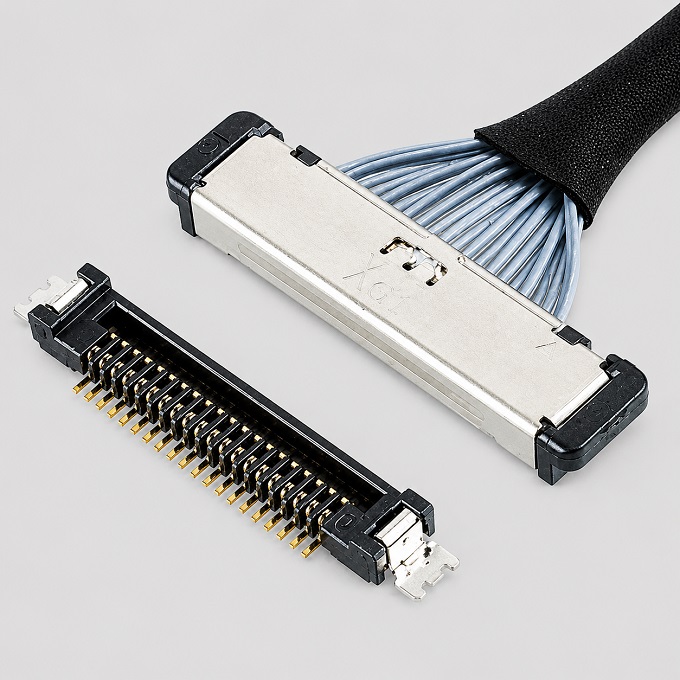
The recommended product this time is the I-PEX 82969-100B-02-D 35P ultra-fine coaxial cable assembly, with a cable length of 300mm, using 35 AWG #40 ultra-fine coaxial cables. The matching cable end connector model is I-PEX 20373-R35T-06. This solution belongs to the I-PEX CABLINE®-SS series, with connectors using a 0.4mm pitch, vertical right-angle mating, and horizontal cable exit structure. The product series supports various ultra-fine coaxial cable specifications, among which the 50Ω micro coaxial cable can correspond to AWG40 or finer specifications. For product designs that require multi-channel high-speed signal transmission within limited space, this combination of "ultra-fine coaxial cable + high-density connector" can provide structural engineers with more flexible wiring space. I-PEX official materials also position CABLINE-SS for applications such as high-speed data transmission, narrow depth, and small-axis transverse.
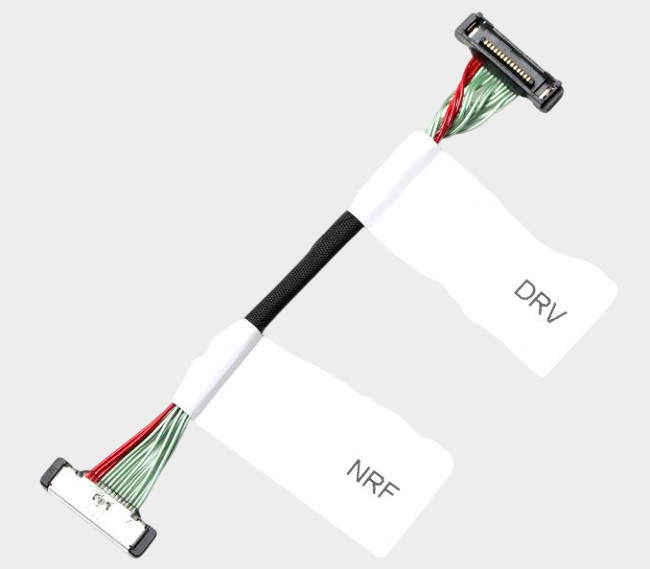
Which is the preferred choice between ultra-fine coaxial cables and FPC/FFC? Engineers should consider the application conditions.
From the perspective of engineering design, there is no absolute "best choice" for ultra-thin coaxial cables, FPCs, and FFCs that exists outside of specific application scenarios. FPCs and FFCs have distinct advantages in large-volume, fixed-shape, short-distance connections, and products that require overall, flat wiring. When there are pivot points, narrow passages, complex three-dimensional routing inside the product, or when high-speed signals require higher impedance control, signal integrity, and anti-interference capabilities, ultra-thin coaxial cable assemblies are usually more worthy of engineers' focused evaluation. Particularly, each cable in ultra-thin coaxial cables has an independent coaxial structure, which allows for targeted design around characteristic impedance, signal path, and shielding structure in high-speed signal transmission applications. Therefore, it is easier to achieve a balance between high density, high speed, and complex spatial layouts. I-PEX has publicly tested the performance of CABLINE-SS using AWG #40, 45Ω, 100mm micro-coaxial cables and has taken V-by-One US 16 Gbps/Lane, HDMI 2.1 12 Gbps/Lane, USB 3.2 Gen2 10 Gbps/Lane, and other applications as reference standards. These data should be understood as the reference capabilities of the product series, rather than a guarantee that can be directly copied for all actual cable lengths, structures, and system designs.
Therefore, for engineers, the question "Which is the preferred choice between extremely thin coaxial cables and FPC, FFC?" should actually be transformed into a more practical one: Which type of connection scheme is more suitable for the current product's high-speed signal, spatial structure, and reliability requirements? If the focus is on ultra-thin fixed connections, regular line shapes, and bulk cost control, it is advisable to focus on evaluating FPC/FFC; if it is necessary to cross axes, achieve three-dimensional wiring, and take into account high-speed signals and narrow spaces, then it is advisable to prioritize evaluating extremely thin coaxial cable bundles. For procurement personnel, it is also necessary to further confirm the connector model, pin count, wire diameter AWG, wire length, pin assignment, terminal molding method, and the matching relationship with the PCB connector, and not to make substitution purchases solely based on the name "35P extremely thin coaxial cable bundle".
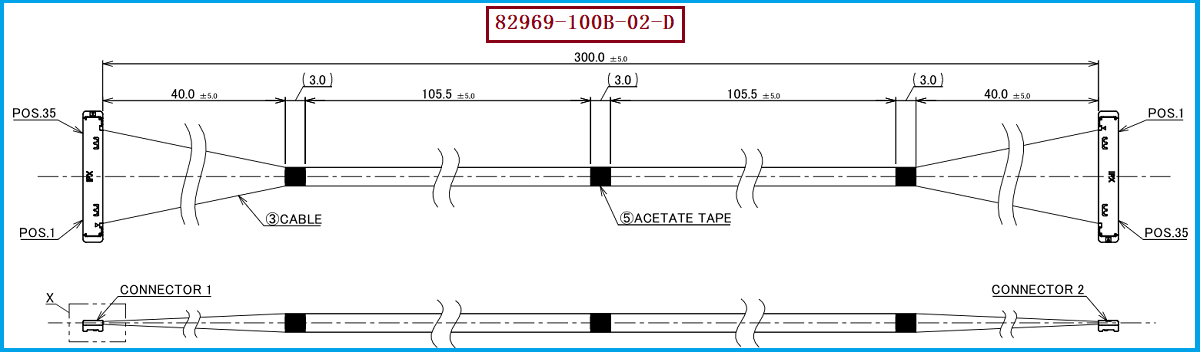
Three, selection and compatibility and alternative solution references and suggestions: from material number corresponding to engineering compatibility
For engineers and procurement personnel involved in product design, BOM replacement, or domestic substitution of the supply chain, it is recommended to prioritize the original scheme's connector interface, Pin count, wire specification, wire length, end structure, and Pin Assignment as core confirmation conditions. This scheme corresponds to the target product model I-PEX 82969-100B-02-D, which is 35P and 300mm in specification, using AWG #40 ultra-fine coaxial wire, and the connector model used at the wire end is 20373-R35T-06. When used in conjunction, attention must also be paid to the corresponding interface system used on the PCB end, as it is not enough to replace the wire while ignoring the mechanical dimensions, electrical interface, and assembly relationship. The CABLINE-SS series uses a 0.4mm pitch, and 35P is one of the standard Pin counts provided by the company. The series structural dimensions include an approximate insertion height of 1.65±0.2mm and a depth of 3mm, suitable for high-density, miniaturized internal connection scenarios.
For procurement alternatives, we recommend not simply using the method of "same specification AWG40 wire + similar connector" to determine whether it can be directly replaced, but to conduct a detailed item-by-item verification from the original factory part number to connector model, pin count, wire AWG, wire length, end size, pin assignment, assembly space, and electrical performance. Especially for this scheme involving 35P, 300mm, and AWG #40 ultra-thin coaxial cables, actual replacement also requires verification in combination with the bending path of the customer's equipment, rotation space, wire harness fixing method, and high-speed signal test results. Our company can provide: 82969-100B-02-D compatible alternative wire harness solution. It can conduct engineering evaluation according to the customer's original I-PEX wire harness specifications and actual assembly requirements, for wire length, wire specifications, end forming, connector matching, and wire harness structure. We provide sample verification and bulk manufacturing support for engineers, helping procurement personnel reduce dependence on single original factory wire harness supply.
Ultra-fine coaxial cable assembly manufacturing capability for engineering validation and bulk procurement
For R&D engineers, the true value of ultra-fine coaxial cable assemblies is not just that "the wire is very thin," but that it can simultaneously solve issues such as high-speed signal connection, cable routing, connector matching, and long-term assembly reliability within limited equipment space; for purchasing personnel, the focus is more on whether the product can be produced stably in large quantities, whether the specifications can be maintained consistently, whether alternative solutions can be smoothly introduced, and whether the supply can be sustained. Referring to the I-PEX 82969-100B-02-D, our company can carry out engineering evaluation and production manufacturing of compatible alternative cable assemblies around the specification system of 35P, 300mm, AWG #40 ultra-fine coaxial cable, and the 20373-R35T-06 cable material end connector. We will confirm the specifications based on the original samples, drawings, or BOM information provided by the customer, and then carry out sampling, assembly verification, and mass production according to the actual product structure. For projects that require original factory replacement, domestic introduction, second supplier development, or cost optimization, we can focus on advancing from five aspects: "interface compatibility + size compatibility + wire specification compatibility + structural compatibility + electrical performance verification."
The extremely thin coaxial cable is not intended to replace all FPCs and FFCs but rather to provide engineers with an alternative, more targeted connection solution under conditions such as high-speed transmission, 3D routing, pivot crossing, high-density connections, and space constraints. This article introduces the I-PEX 82969-100B-02-D 35P/300mm extremely thin coaxial cable assembly, which uses AWG #40 extremely thin coaxial cables and is matched with the 20373-R35T-06 connector, and is suitable as a reference object for high-speed, high-density connection solutions inside relevant equipment.
I am【7A Electronic Network】Professional custom production of extremely thin coaxial cable assemblies and matching connectors, terminal blocks, and board-to-board connectors. If you need technical evaluation or project cooperation, please contact: Yin Manager18013280527 (WeChat number).
“Without the consent or authorization of this site, no one shall reproduce, reprint, distribute, cite, change, broadcast or publish the content in whole or in part in any form, nor shall there be any other violation of the copyright of this site.